
AI Model Pricing & Benchmarks
Compare AI model pricing trackers, token cost calculators, and benchmark leaderboards. Check rate freshness, caching and reasoning math, and score sources.
1 tool, updated November 2026
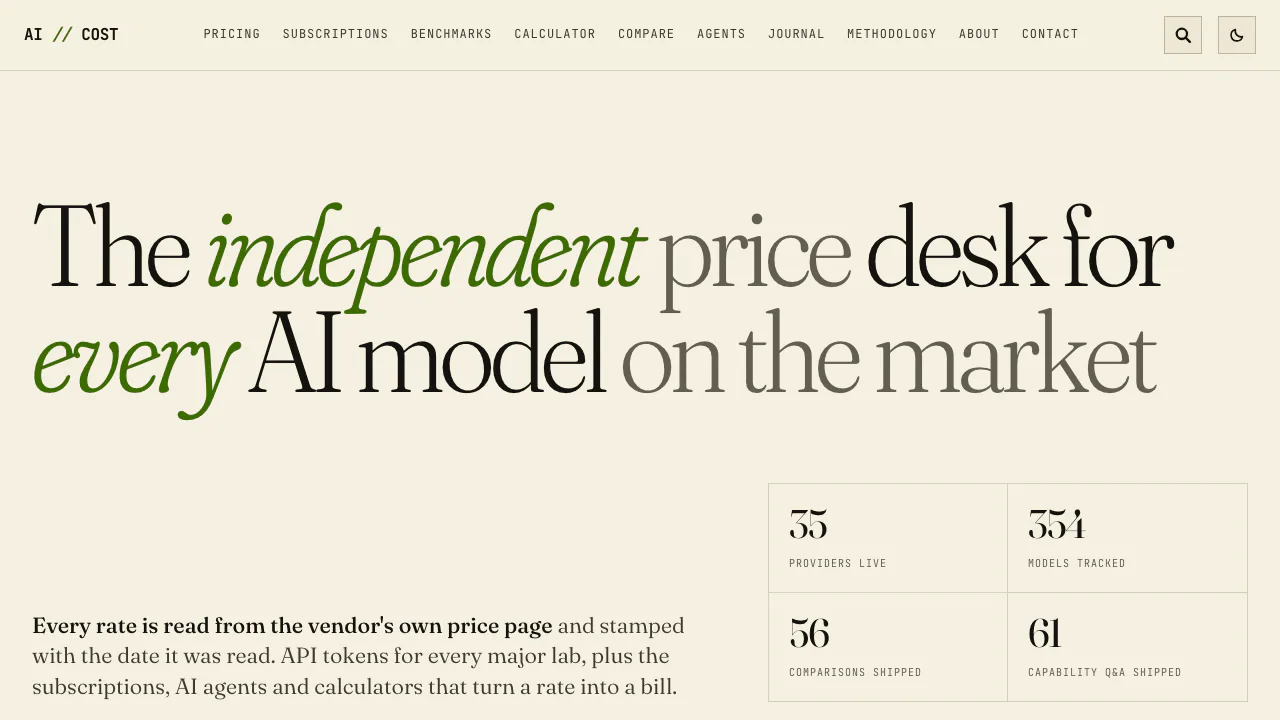

AI model pricing and benchmark tools help developers, product teams, and researchers compare token rates, subscription tiers, workload costs, and evaluation scores across model providers before committing budget (as of November 2026). Use this page to separate static rate cards and workload calculators from live API gateways or prompt-testing playgrounds.
How to choose an AI pricing or benchmark tool
- Source provenance and freshness: Model providers change token prices, context thresholds, and deprecations frequently. Check whether each price or score links back to a canonical vendor page or named evaluation harness and stamps the exact date it was verified, rather than repeating undated numbers.
- Real-world cost levers beyond base tokens: Raw input and output rates rarely match production bills. Look for calculators that account for prompt-cache hit rates, cache-write premiums, async batch discounts, and hidden reasoning tokens billed at output rates.
- Direct vendor rates vs gateway resale pricing: Distinguish independent reference desks that track first-party lab pricing from unified API gateways that route traffic and add platform or credit top-up fees. Also check whether monthly chat and coding subscriptions are kept separate from per-token API tables.
- Benchmark methodology and task fit: Leaderboard averages can hide saturated tests or inconsistent reasoning-effort settings. Prefer tools that separate independent harness runs from vendor self-reports and show cost per completed task alongside raw accuracy.
- Export and licensing boundaries: Check whether you can export scenarios to CSV, embed calculators, or pull machine-readable JSON legally, as many reference databases prohibit scraping without a data license.
Picks by workflow
- Good fit for auditing vendor-direct API rates and modeling agent or caching bills: AI//COST, because it pairs manually dated vendor rate cards with free browser calculators for reasoning tokens, prompt caching, batch tiers, and subscription-versus-API break-even without requiring an account (checked November 2026).
FAQ
Why does my real LLM API bill differ from per-token list prices?
List tables show base input and output rates per million tokens, whereas real workloads accumulate system prompts, multi-turn tool outputs, retries on rate limits, cache writes, and hidden chain-of-thought reasoning tokens billed at output rates. Use a workload calculator that lets you adjust cache hit ratios and thinking-token budgets.
Are AI subscription prices comparable to API token rates?
No. Consumer and coding subscriptions sell rolling five-hour, daily, or monthly usage pools with product guardrails, while APIs bill exact tokens consumed. Compare them by modeling your expected daily messages and token volume in a subscription-versus-API break-even calculator.
How can I tell if an AI benchmark leaderboard is trustworthy?
Check whether every score cites the exact evaluation version, reasoning effort, verification date, and whether an independent leaderboard ran the test under a uniform harness or a model vendor self-reported the figure in a launch post.