

guilds.runFree
Run agent teams and inspect their prompts, tools and memory.
Bevel AI consulting services for enterprise agents
Enterprise AI agents built in your infrastructure, with Hexis for shared context and tools.
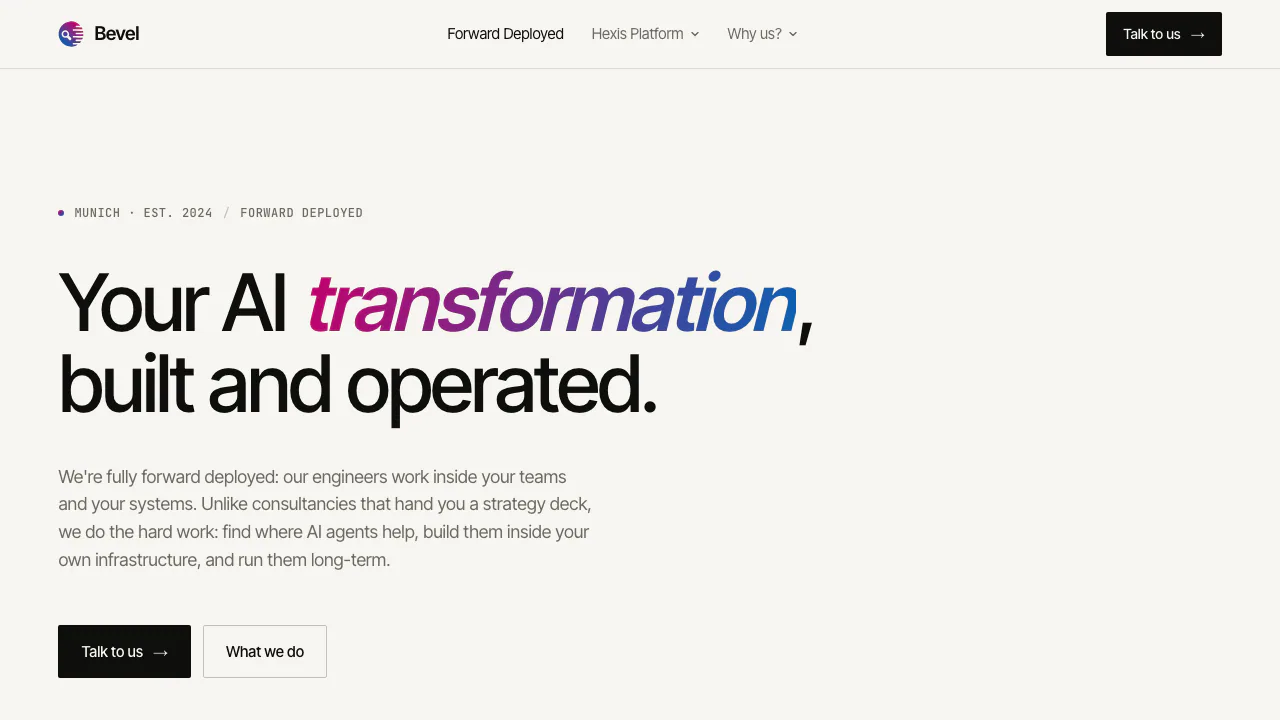
What Bevel does, in plain English
Bevel provides AI consulting services with hands-on engineering and ongoing operation. Its engineers work alongside a company's teams, identify suitable workflows and build agents inside the company's infrastructure. The operator is Bevelites GmbH in Munich.
Think of it as a team that turns a business routine into a maintained AI system. If employees repeatedly assemble information from several systems, Bevel can investigate the process and build an agent around it. Hexis is the accompanying platform for sharing approved knowledge, reusable instructions and tool access across assistants. The service and the platform have separate commercial boundaries.
From business process to a maintained AI agent
Bevel describes three stages:
- Find: interview staff and inspect company information sources to map how work happens. The resulting knowledge nodes include provenance, live in the customer's repository and can be corrected by people.
- Build: integrate agents with existing systems. Context, skills, tools and permissions are recorded in the repository, making their instructions and access reviewable.
- Operate: monitor and maintain deployed agents. Reviewed changes to a shared fact or skill can improve every agent using it; agents that fail to deliver value can be retired.
This suits operations and IT teams that need integration and maintenance. Official customer accounts describe campaign work, market intelligence and electronics procurement. These illustrate use cases; they do not establish a guaranteed saving or delivery timeline.
How Hexis gives a team shared context and tools
Hexis addresses a practical team problem: different assistants can otherwise work from different prompts and outdated company information.
- Reviewed context: knowledge pages have owners, approval steps and version history.
- Shared skills: colleagues suggest improvements in the browser; owners approve changes before agents receive them.
- Connected tools: the platform lists HubSpot, Notion, Jira, Confluence, Google Drive, GitHub, Gmail and other services, with support for MCP servers or APIs.
- Role-sensitive access: files, skills and tools follow permissions for the person using an agent.
An MCP-compatible assistant connects to a common endpoint. Hexis keeps tool credentials on the server and lets agents discover relevant tools when needed.
A practical sales-offer workflow
The official example prepares a customer offer. Start with an approved pricing strategy, a shared sales skill and an authorized CRM connection. Connect a compatible assistant to Hexis, then ask it to draft an offer for a named customer.
The assistant uses the skill, checks approved pricing and retrieves past HubSpot deals. Its output is a Markdown proposal for a person to review. Before using it, check the amounts, customer details and source context. Restricted information should remain unavailable to users without permission. This shows how company knowledge and business tools contribute to one task.
Service quotes and Hexis pricing
Checked on 14 October 2026, the engineering partnership has no public fixed price; discuss its scope with Bevel. Do not use a Hexis seat price as a quote for custom development.
The official Hexis pricing advertises hosted Free for up to three people, Team at €10 per person per month, excluding VAT, and custom Enterprise terms. Hexis also offers self-hosting of its open-source core. These are published euro conditions, not a local-currency price or a promise that infrastructure, AI usage and engineering are included.
Data access, retention and self-hosting
Hexis keeps knowledge and skill changes in a customer-controlled Git repository, provides granular access and audit logs, and offers an Apache-2.0 self-hosted core. Access control determines which information an agent may use; it does not make every answer correct.
The privacy policy describes external processors, including OpenAI for inference. It says OpenAI API data is not used to train OpenAI models and describes US processing. Git history retains earlier knowledge versions; chats and uploaded files remain until removed with application controls. Check the processing and retention terms for the planned deployment before connecting sensitive sources.
Frequently asked questions
How much does Bevel cost?
Engineering is quoted separately. Hosted Hexis has a three-person free boundary, a paid Team plan and custom Enterprise terms.
Can Hexis connect to existing AI assistants?
Yes. Hexis lists Claude, ChatGPT, Cursor, Claude Code and Codex, plus other MCP-compatible clients. Tool connections still require the appropriate credentials and permissions.
Does self-hosting mean data never leaves the company?
No such blanket guarantee follows from self-hosting. It controls where the software runs, while inference and connected services may still process data elsewhere.
Official resources
- Discuss a project with Bevel: book a meeting to scope the service.
- Hexis code and deployment documentation: inspect the license, setup instructions and configuration.
- UTCP specification and developer resources: explore the team's tool-calling protocol.
Related tools
AI Consulting Services →
SalesRepPaid
Qualify leads, share product quotes and hand conversations to your team from one inbox.
SquadRoomPaid
Give specialist agents a task, then review the work, documents and report.
NovastartFreemium
Arrange real app windows, follow AI agents and share a working canvas.
AyvenFreemium
An AI coordinator for following up with people, tracking tickets and keeping long-running team work moving.
MeleteContact
AI agents that turn connected work into reviewed plans and follow-ups.