
KodloPaid
Find suitable prospects, check the evidence and prepare outreach in one sales workspace.
Melete: AI Agents for Team Workflow Automation
AI agents that turn connected work into reviewed plans and follow-ups.
What does Melete actually do?
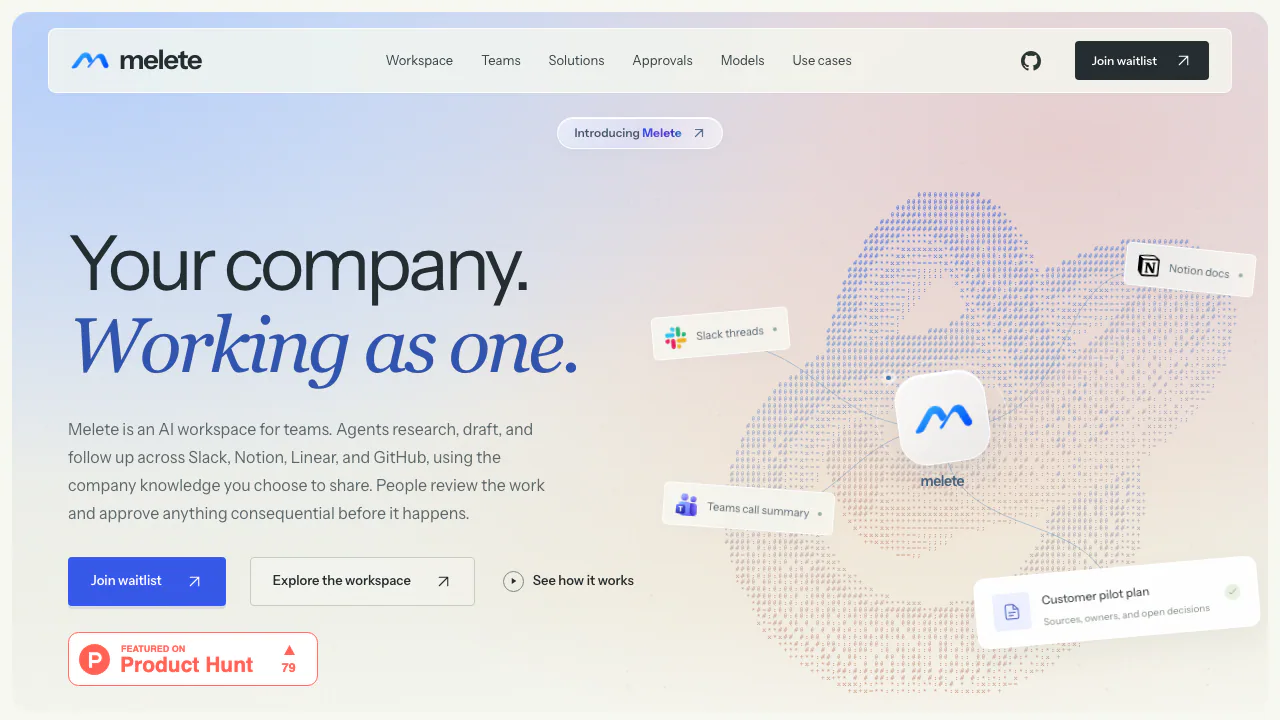
Melete is an AI workspace for delegating work that spans several apps. You describe an outcome, supply the relevant sources and let an agent prepare a result for review. For example, it can turn call notes, a customer record and a Slack discussion into a pilot plan with goals and owners. It also supports personal use without a company workspace.
The hosted service currently has a waitlist. The public workspace is a demonstration, explicitly described as different from the real product. The official repository separately offers a self-hosted personal agent in early beta.
Turn scattered context into a usable handoff
The team website describes workflows across tools such as Slack, Notion, Linear, Google Drive and GitHub. Its useful outputs are concrete: a weekly update, a customer handoff, a launch brief or a research memo with sources and unresolved questions.
For a first pilot, choose one recurring handoff and name the person responsible for the result. Connect only the required channels, documents and records, initially with read-and-draft access. Ask for a sourced plan, check its dates, success criteria and owners, then review any message before sharing it externally. Scheduled summaries and change checks can keep the same workflow moving between sessions. A displayed app logo does not establish that every integration is available in every deployment.
The site also describes sharing and exporting these documents; a complete export-format list is not verified.
Keep memory and actions within the right boundaries
Melete describes three memory scopes: company, project and private. Entries link to their sources and can be inspected, corrected or deleted. Sharing a task exposes that task's brief and decisions rather than your entire conversation history.
The team approval flow shows a proposed action to a named reviewer and records the decision. Browser, file and code work runs in a separate task environment. If an action cannot be confirmed after an interruption, the website says it is flagged for checking instead of blindly retried. These controls help review the work; they do not make AI output automatically correct.
Choose a cloud pilot or a self-hosted beta
For hosted access, use the Melete Cloud waitlist or the company form on the homepage. Describe a bounded workflow and the tools it needs.
Technical users can follow the official deployment guide. It documents Docker Engine 28.0 or later and Compose 2.33.1 or later. After installation, open the local interface on port 3101 and create an account. A practice model lets you inspect the app; connect a real provider under Settings → Models for actual model use. Configure connections separately and review a small task before expanding access. The personal beta should not be assumed to reproduce every advertised team feature.
The self-hosted documentation also covers mail, calendars and MCP servers, each requiring its own connection setup.
Model choice, licensing and running costs
The team site names OpenAI, Anthropic and Google models, plus local servers exposing an OpenAI-compatible API. Projects, documents and memory remain in the workspace when models change.
Checked on 12 October 2026: no public hosted price table, fixed free quota or market-specific currency was available in the reviewed pages. The repository uses Apache-2.0; model usage, infrastructure and optional external services can still cost money. Confirm cloud terms for your intended deployment before committing.
Understand where task data goes
The privacy policy says Melete does not sell personal information or use your content to train models. Task content may still be processed by a model provider, and a provider you select has its own terms. Self-hosting therefore does not automatically make a cloud model local.
The policy gives a purpose-based retention rule rather than a fixed number of days. The service terms state that users retain rights to their content and output, while remaining responsible for permissions and checking AI results.
Frequently asked questions
Is Melete free?
The open-source code and a free hosted plan are different things. No public cloud free allowance was verified; self-hosting still requires suitable infrastructure and a model configuration.
Can I use a local AI model?
Yes, the website describes model servers with an OpenAI-compatible API. You need to configure and operate that server; changing the model does not remove connected-service requirements.
Does Melete use my content for training?
Its policy says it does not. Check the terms of your chosen model provider as well, because task processing can involve that provider.
Official resources
- Source code and license: inspect the beta and its documentation.
- Contact Melete: discuss a team pilot or commercial conditions.
- Official X account: follow product announcements.
Related tools
AI Automation Tools →
AyvenFreemium
An AI coordinator for following up with people, tracking tickets and keeping long-running team work moving.
AncherFreemium
Save your sources, find them by meaning, and turn them into useful work.
IncrediblePaid
Delegate browser, app and file work by voice or text.
RillFree
Turn the page you are reading into work for your own coding agent.
Pilot5 LegalFreemium
Review US legal matters with source checks and five-model deliberation.