

TypelessFreemium
Speak a draft and turn it into editable writing
deepidv Identity Verification and Deepfake Detection API
Identity verification, liveness and deepfake detection APIs for digital onboarding and fraud review.
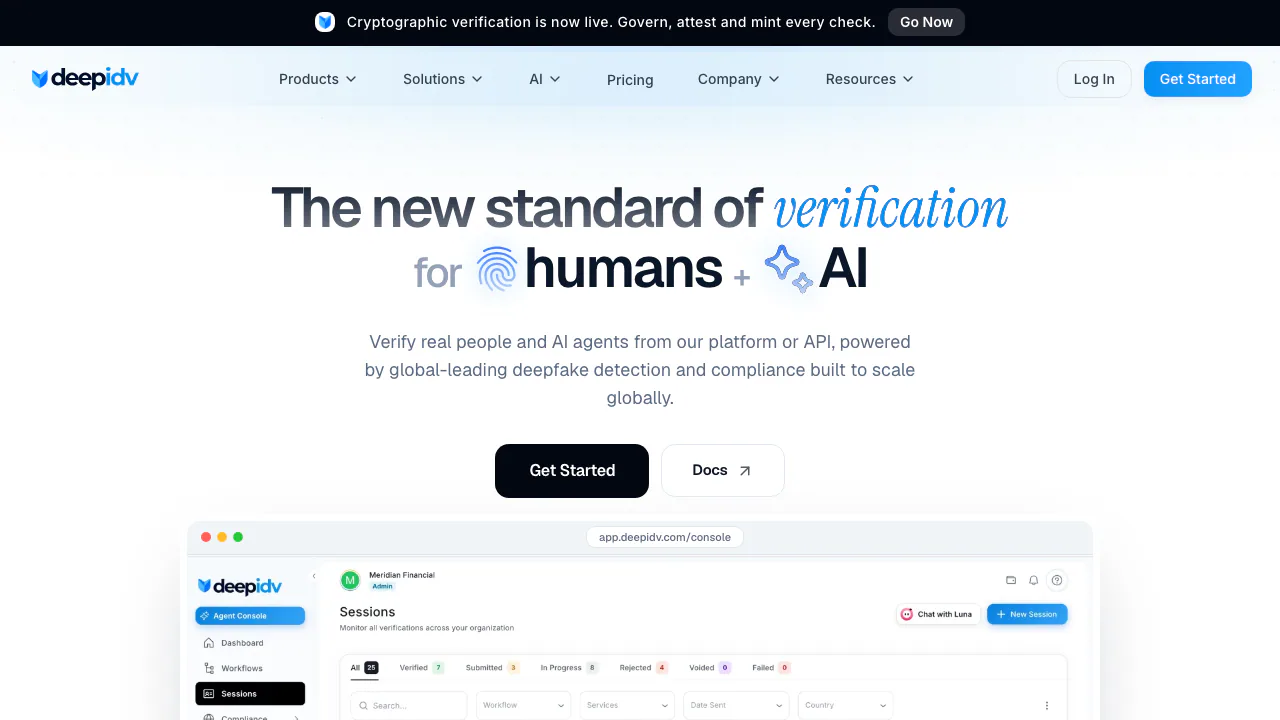
deepidv is an API-first identity verification and fraud-prevention platform from Deep Identity Inc. It combines document checks, selfie liveness, face matching, KYC and KYB screening, and deepfake analysis in one product family. Teams can use a hosted verification flow, integrate SDKs, call REST APIs directly, or assemble no-code workflows.
What does deepidv do, in plain English?
In simple terms, deepidv helps a business check whether a remote user is a real person, whether the identity document appears genuine, and whether the submitted face matches the document portrait. It can also inspect images, video and audio for signals associated with AI generation or manipulation.
A typical customer sends the user into a verification session. The user photographs an identity document and takes a live selfie. deepidv analyzes the document, performs liveness checks and face comparison, then returns results that the customer can use in an onboarding or fraud-review workflow. It is an input to a decision, not a substitute for human review or legal advice.
Identity verification workflow
The hosted flow is the quickest route for a team that does not want to build every screen. Web and mobile SDKs provide more control over capture and branding, while server APIs support custom back-end orchestration. The documentation also describes direct API calls for teams that want to run individual checks rather than a complete session.
Core identity tasks include document authentication, data extraction, face liveness and face matching. The wider platform advertises KYC, KYB, AML, sanctions and PEP screening, plus risk and fraud signals. Coverage and legally acceptable documents vary by country and use case, so buyers should confirm their exact market before launch.
Deepfake and presentation-attack detection
deepidv offers separate analysis for AI-generated faces, face swaps, morphs, manipulated video, synthetic audio and voice clones. Its product page describes image and video APIs, real-time SDK use and batch processing, with confidence scores returned to the customer.
A score should be treated as a review signal rather than proof by itself. Test with representative cameras, compression levels, languages, attack types and demographic groups. Teams making high-impact decisions should define escalation, appeal and manual-review paths before automating rejection.
Integrations and developer experience
The vendor presents deepidv as modular and API-first. Available routes include REST APIs, hosted sessions, webhooks, a sandbox and SDK support for web, iOS, Android, React Native and Flutter. The site also mentions server-side examples for Node.js, Python and Go, plus an MCP option for agent-oriented workflows.
A practical evaluation should check authentication, webhook signing, retries, idempotency, error codes, data retention controls and regional requirements. Start in the sandbox with a small set of representative documents, then measure completion rate and false-review load before expanding.
Pricing and trial model
The official pricing page showed pay-as-you-go pricing when checked on September 4, 2026. It listed a free first month followed by a $19 monthly maintenance charge, with usage billed per check. At that time, identity verification with face liveness was listed at $0.50 per verification and deepfake detection at $0.60 per check. Enterprise and agent-focused plans use separate pricing.
Prices, included credits and product bundles can change. The vendor has also displayed different figures on feature pages, so confirm the current checkout or sales quote instead of budgeting from this summary alone.
Privacy, security and compliance notes
According to the vendor trust portal, data is encrypted with AES-256 at rest and TLS 1.3 in transit, and customer data is isolated. The portal says biometric data used solely for liveness is deleted within 24 hours and that infrastructure may store data in the United States or Canada.
The vendor reports SOC 2 Type II, ISO 27001:2022 and GDPR alignment. Other items shown as “in progress” should not be treated as completed certifications. Before production, review the DPA, subprocessors, retention settings, lawful basis, consent language and data-residency fit for every target market.
Who is deepidv best for?
deepidv is most relevant to fintech, marketplaces, age- or access-controlled services, hiring and background-screening workflows, and products that need identity checks plus synthetic-media risk signals. It can suit teams that value one API family and multiple integration routes.
It may be a weaker fit when a company needs a fully managed compliance program, guaranteed local data residency, or evidence of independent accuracy for a very specific population. In those cases, request benchmark data and compare specialist providers.
Frequently asked questions
Is deepidv an identity verification API?
Yes. It provides hosted verification sessions and APIs for document checks, face liveness and face matching, alongside broader KYC, KYB and fraud modules.
Is deepidv free?
It is not a permanently free service. The official pricing page advertised a free first month when reviewed, followed by a maintenance fee and per-check usage charges. Verify the current offer before signing up.
Can deepidv detect deepfakes?
The vendor offers detection for manipulated or AI-generated image, video and audio content. Results are confidence-based risk signals and should be tested against your own traffic.
Where can I check technical and privacy details?
Use the developer documentation, pricing page, trust portal, privacy center and support page.
Related tools
AI Identity Verification & Fraud Prevention →
Give your existing AI agent product answers and contextual walkthroughs.

Mastra FactoryFreemium
A shared software factory for coding agents and human reviewers.
Gojiberry AIPaid
Find relevant B2B prospects and prepare personalized LinkedIn and email outreach.
MagicSlidesFreemium
MagicSlides is an AI presentation maker that turns a topic, written content or source material into a slide deck you can refine
RelaticleFreemium
An open source CRM for customer records, sales pipelines and AI-assisted work.