

TypelessFreemium
Speak a draft and turn it into editable writing
HydraDB: Graph Database and Context Layer for AI Agents
Open-source graph database and context layer for stateful AI agents
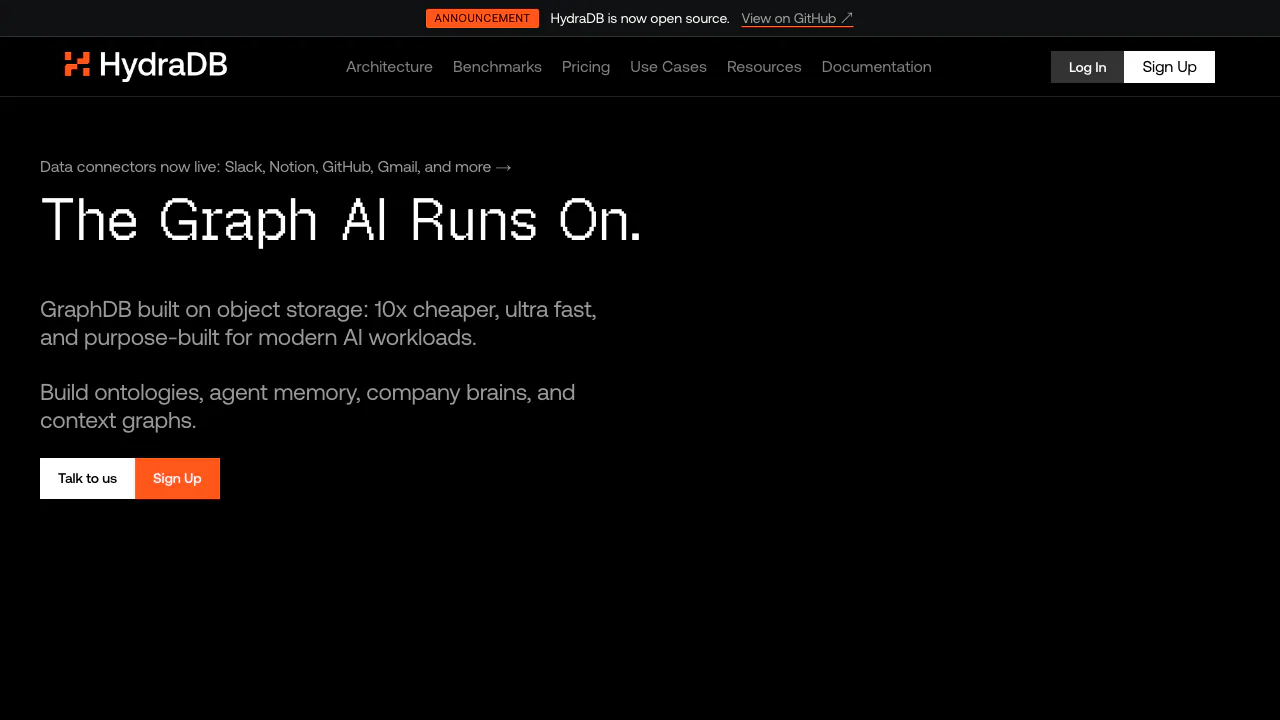
HydraDB is an open-source graph database and managed context platform for teams building stateful AI agents. It combines graph relationships, semantic retrieval, memories, knowledge, and object-store-native infrastructure so applications can retrieve connected context instead of relying only on isolated vector matches.
In plain language, what does HydraDB do?
HydraDB gives an AI application a structured memory. You can store what a user prefers, what happened in earlier sessions, facts from documents, and the relationships between people, projects, events, and concepts. When the agent receives a new question, HydraDB can search those sources and return relevant, connected context.
This makes it useful when a chatbot or copilot must remember users, reason across related information, or maintain knowledge over time. HydraDB is infrastructure for developers rather than a finished consumer chatbot.
Graph database core and architecture
The open-source HydraDB core is a distributed graph database written in Rust. Its repository describes an object-store-native design in which S3-compatible storage is the durable source of truth, with memory and NVMe used as faster tiers. It supports a practical OpenCypher subset, Neo4j-compatible Bolt 5.x access, HTTP APIs, snapshot-consistent reads, and GraphBLAS-based traversal.
The managed product adds context orchestration around the database. Its query pipeline can combine metadata filters, semantic and keyword retrieval, and graph traversal. Performance figures published by HydraDB are vendor benchmarks, so teams should reproduce representative tests with their own graph size, query mix, and deployment.
Agent memory, knowledge, and context graphs
HydraDB separates user-scoped memories from shared knowledge. Memories can preserve preferences, history, identity, or exact facts; optional inference can extract useful preferences from an interaction. Knowledge ingestion supports common document and application sources and relates the resulting facts in a context graph.
Queries can target memory, knowledge, or both. Fast and reasoning-oriented modes, metadata filtering, and optional graph context help developers control the trade-off between latency and richer retrieval. Typical uses include support agents, coding assistants, research copilots, internal knowledge assistants, and personal “second brain” products.
Developer integration
Developers can start with a hosted API key and create a database, ingest knowledge or memory, wait for indexing, and call the query endpoint. Official SDKs are documented for Python and TypeScript, while REST endpoints support other stacks. HydraDB also documents integrations such as MCP, Claude Code, a CLI, and OpenClaw.
A sensible evaluation starts with a small, representative dataset. Check entity modeling, metadata design, ingestion latency, retrieval quality, deletion behavior, observability, and tenant isolation before moving production workloads.
Open source and deployment choices
The database core is available under the AGPL-3.0 license and can run through containers or Kubernetes. HydraDB also offers a hosted service, dedicated infrastructure, and higher-tier self-host or bring-your-own-cloud options. Open-source availability does not mean the managed cloud is free, and teams embedding or modifying AGPL software should review the license for their distribution model.
Pricing
The hosted pricing page checked on September 4, 2026 listed a free Ship plan, a Surge plan at $25 per month with 2 GB included, and a Scale plan at $399 per month with 10 GB included. Storage overages were listed separately, while enterprise pricing was custom. Features such as dedicated infrastructure, compliance documents, support levels, and self-hosting vary by plan.
Pricing and limits can change, so verify the current plan page before budgeting. Compare total stored graph data, indexing growth, backup needs, and operational costs rather than looking only at the entry price.
Data, privacy, and practical considerations
HydraDB is operated by AGI Context, Inc. Its terms distinguish downloaded software from the managed service and treat AI inputs and outputs as customer data. The policies also grant rights needed to operate and improve the service, place backup responsibility on the customer, and state that security and uninterrupted availability cannot be guaranteed.
Before storing sensitive or regulated information, review the current terms, privacy policy, data processing agreement, retention and deletion controls, region options, backup strategy, and security reports. Validate any advertised connector in the current dashboard because website sections may describe availability differently.
Who should consider HydraDB?
HydraDB is a strong candidate for engineering teams that need graph-native agent memory, connected knowledge retrieval, multi-tenant context, or an object-storage-oriented graph database. It may be more infrastructure than necessary for a simple FAQ bot or small semantic search project. Run a proof of concept against alternatives such as a vector database, a conventional graph database, or a relational database with retrieval extensions before committing.
Related tools
AI Databases & Context Infrastructure →
Give your existing AI agent product answers and contextual walkthroughs.

Mastra FactoryFreemium
A shared software factory for coding agents and human reviewers.
Gojiberry AIPaid
Find relevant B2B prospects and prepare personalized LinkedIn and email outreach.
MagicSlidesFreemium
MagicSlides is an AI presentation maker that turns a topic, written content or source material into a slide deck you can refine
RelaticleFreemium
An open source CRM for customer records, sales pipelines and AI-assisted work.