

ColossyanFreemium
AI avatar videos, interactive courses and multilingual training from existing content
SeaArt AI Art Generator for Images & Video
Generate images, videos, avatars, and voices with AI
What is SeaArt AI?
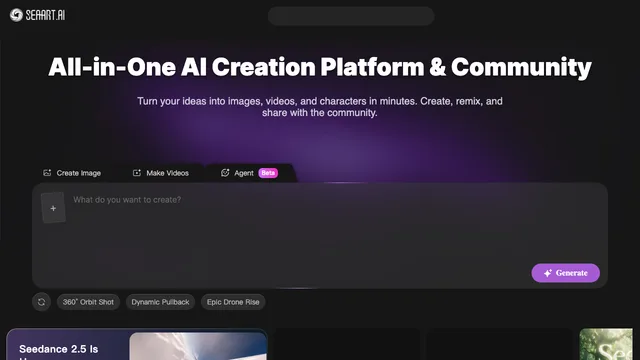
SeaArt AI is an all-in-one AI art generator and creative community for producing images, videos, character portraits, speech, music, and talking-character clips. The official homepage offers image and video creation, model selection, one-click effects, editing tools, community remixing, and an agent that can turn a conversation into visual content. Its model hub currently surfaces systems such as Veo, Sora, Wan, Kling, PixVerse, Vidu, Nano Banana, GPT Image, Seedream, and FLUX alongside community models and LoRAs.
SeaArt is broader than a basic text-to-image page. It combines prompt-based generation, image-to-image work, model training, ComfyUI, face and portrait tools, video generation, AI audio, and a public creator ecosystem in one account.
seaart ai video: AI art generator, video, and editing features
- Text-to-image and image-to-image: Generate anime, illustration, photorealistic, poster, product, and character imagery from a prompt or reference image. Users can select models, LoRAs, aspect ratios, batches, and advanced settings.
- AI video generation: Create clips from text, images, references, and templates. The official homepage currently highlights camera movements, reference-to-video, 30-second video, motion effects, face dance, and multiple video-model families.
- Conversational creation agent: The SeaArt Agent generates images and videos from natural-language conversations and can assist with enhancement, background removal, restoration, and visual effects.
- Image editing tools: Upscaling, AI filters, erasing, background removal, face swap, makeup, sketch-to-image, prompt extraction, and inpainting are available through the image editor and AI Apps.
- Models, LoRA, and ComfyUI: SeaArt hosts official and community resources, supports LoRA training for all users with a variable Credit cost, and exposes configurable ComfyUI workflows. The current Mall FAQ says model merging is not yet available.
- Community and creator tools: Users can publish, remix, save, comment on, or sell access to artwork, models, and LoRAs. Public content has different licensing and privacy consequences from private creation.
SeaArt AI: Avatars, AI voices, and lip sync
SeaArt supports both avatar-style visuals and generated speech:
- Its AI Face Generator creates synthetic faces, headshots, creator avatars, campaign models, and digital humans from text or an uploaded portrait. A generated face can then be animated or made to speak.
- The AI Voice Generator converts text to multilingual speech and supports custom voice training. The official guide documents English, Japanese, and Chinese text-to-speech.
- The AI Voice Cloning workflow focuses on character audio, songs, short scenes, and lip-sync use rather than claiming a full professional dubbing studio.
- The AI Lip Sync Generator accepts a portrait, cartoon, or video plus generated or uploaded audio, then creates synchronized mouth movement. Text-to-speech voices can be adjusted for speed, tone, and emotion.
Voice and likeness rights still matter. SeaArt's terms prohibit uploading people without consent and creating images of public figures, while the voice page advises users to obtain any rights needed for commercial use of a likeness or voice.
seaart ai app: Pricing, Stamina, and Credits
SeaArt uses two consumption units:
- Stamina is a daily allowance that expires at the end of the day and does not accumulate.
- Credits are used after Stamina is depleted and can pay for image and video generation, AI Apps, model training, AI chat, and other workflows. Costs vary by model and settings.
The live SeaArt Mall checked on August 20, 2026 showed a limited-time monthly promotion. Prices exclude tax and the Mall warns that displayed prices are estimates affected by exchange rates:
- Free: one answer in the current Mall FAQ lists 130 Stamina per day and approximately 21 standard image generations, while another answer on the same page says users can claim 0 daily-login Stamina. Because those official statements conflict, verify the balance shown in a new account. Most standard images are described as costing about 6 Credits, but actual image and video costs depend on the selected model.
- Beginner SVIP: US$5.99 per month during the displayed promotion, with 300 Stamina per day, shown as roughly 1,500 standard images per month.
- Standard SVIP: US$25.49 per month during the promotion, normally shown as US$29.99, with 1,800 Stamina per day and roughly 9,000 standard images per month.
- Professional SVIP: US$50.99 per month during the promotion, normally shown as US$59.99, with 4,000 Stamina per day and roughly 20,000 standard images per month.
- Master SVIP: US$127.49 per month during the promotion, normally shown as US$149.99, with 12,000 Stamina per day and roughly 60,000 standard images per month.
The main plan cards and the FAQ text can lag each other during promotions, so the checkout screen and account balance are the final authority. Higher tiers add more concurrent tasks, speed, model-training capacity, high-quality or private creation, and other plan-specific benefits.
The same Mall offered purchased Credit packs such as 700 Credits for US$0.99, 3,800 for US$4.99, 8,200 for US$9.99, and 17,600 for US$19.99. Packs and bonuses can change. Purchased Credits obtained on or after April 1, 2026 are valid for two years; event Credits earned from that date can have a validity period from 90 days to two years, depending on the event. This supersedes older guide text that described Credits as never expiring.
Subscriptions can renew automatically. SeaArt recommends canceling a three-day trial at least one day before charging because processing may occur early, and its terms generally describe membership payments as non-refundable.
SeaArt AI: Commercial use and content licensing
The official Mall FAQ says intellectual-property rights in content generated by a user belong to that user and that SeaArt does not prohibit commercial use. Creators can use their own output in client work, marketing, product designs, or social campaigns, but they assume the related legal risk.
Commercial permission is not a guarantee that every output is clear of third-party rights. Users must have rights to prompts, uploads, training material, models, likenesses, brands, and any other source material. A community work or model does not automatically transfer its creator's rights: authorization and any resource-specific license may still be required.
The Terms of Service say uploaded or published content remains owned by the user or original copyright owner. If content is made public, the user grants SeaArt, its affiliates, and other users a worldwide, perpetual, sublicensable license to use, store, distribute, display, and create derivative works through the service. SeaArt may use public content for promotion. Private content is described as accessible only to the user, subject to reasonable confidentiality measures.
seaart ai app: Privacy and important limitations
The Privacy Policy says SeaArt collects account, social-login, billing, support, IP, transaction, security, chat, survey, uploaded image/video, and usage data. It may analyze, profile, and segment collected data and share information with service providers, group companies, other users through social features, authorities, or a business acquirer. Information may be transferred across borders.
For face swap and video synthesis, SeaArt says facial features are analyzed with authorization. The policy states personal facial-feature information is stored on the user's device and is not stored, shared, or processed elsewhere by SeaArt or third parties. Uploaded photos and videos are still inputs to the service, so users should avoid confidential or non-consensual material.
Important practical limits include:
- Generation cost, speed, resolution, duration, and availability vary by model, queue, region, plan, and input complexity.
- Free Stamina resets daily and cannot be saved; generation stops when both Stamina and Credits are insufficient.
- Purchased and event Credits now have time limits under the current Mall rules, despite older help pages saying they never expire.
- The service applies strict content moderation. The terms prohibit non-G-rated, violent, sexual, political, harmful, deceptive, infringing, and public-figure content, and require disclosure rather than misleading an audience about AI involvement.
- AI moderation can misclassify work. SeaArt's Chinese FAQ acknowledges automated and human review may produce false positives.
- Public posts grant a broad, perpetual license and may be used for promotion. Check the visibility setting before generating sensitive concepts.
- SeaArt does not guarantee community UGC is non-infringing. Reusing another creator's work, model, or LoRA requires license review.
- Accounts may be suspended or terminated for policy violations; the terms say remaining Credits can be lost and account-linked content may become inaccessible after termination.
- Up to three devices can be signed into one account at the same time, and concurrent task limits depend on the plan.
SeaArt AI: Who is SeaArt best for?
SeaArt fits creators who want a single workspace for anime and photorealistic images, video models, LoRA and ComfyUI experimentation, avatar portraits, voice generation, lip sync, and community discovery. It is less suitable for teams that need simple, predictable per-output pricing, minimal community exposure, a narrow professional editing workflow, or permissive generation policies. Commercial teams should test the exact model, review its license, keep creations private when needed, and document consent for every face and voice.
seaart ai app: Frequently asked questions
Is SeaArt an AI art generator?
Yes. SeaArt generates and edits images from text or reference images, supports official and community models and LoRAs, and also includes video, audio, avatar, lip-sync, training, and ComfyUI workflows.
Is SeaArt free to use?
Yes, but the exact free allowance is not stated consistently. One current Mall FAQ answer lists 130 daily Stamina, roughly enough for 21 standard images, while another says 0 daily-login Stamina. Check the balance shown in a new account; actual output count also varies by model and settings.
What is the difference between Stamina and Credits?
Stamina is a daily balance that expires and cannot roll over. Credits are used when Stamina is insufficient and can be purchased or earned. Purchased Credits acquired from April 1, 2026 are valid for two years; event Credits can expire sooner.
Can SeaArt generate AI video?
Yes. It supports text-, image-, reference-, and effect-based video creation across multiple video models. Cost, duration, resolution, and processing time depend on the selected model and plan.
Does SeaArt create avatars and talking photos?
Yes. The face generator can create synthetic portraits, digital humans, headshots, and creator avatars. Lip Sync can animate a portrait or video with uploaded audio or text-to-speech.
Does SeaArt have an AI voice generator?
Yes. It offers multilingual text-to-speech, custom voice training, voice-style audio, songs, and voices for lip-sync scenes. Users must have permission to use a real person's voice or likeness.
Can SeaArt output be used commercially?
SeaArt says it does not prohibit commercial use of a user's own generated content. The user remains responsible for model licenses, source material, likeness rights, trademarks, and possible infringement. Other users' works require their authorization.
Are SeaArt creations private?
Only when they are not set to public. Public content grants SeaArt, affiliates, and users a broad perpetual license and may appear in promotion. Private creation is a plan-dependent feature, so verify visibility before generating confidential work.
Do SeaArt Credits expire?
Under current Mall rules, purchased Credits obtained on or after April 1, 2026 expire after two years. Event Credits obtained from that date can be valid for 90 days to two years. Older official guides may still show the previous no-expiry rule.
Related tools
AI Image & Video Generators →
D-IDPaid
Turn photos and scripts into talking AI avatars
AKOOLFreemium
Create AI avatar videos, face swaps, translations, and voices in one suite
PixelcutFreemium
AI photo editing and product-content creation for sellers and brands
Lumen5Freemium
Turn ideas and articles into branded videos with AI
FlikiFreemium
Turn ideas, scripts, articles, and slides into narrated videos with AI voices and avatars.