

Mastra FactoryFreemium
Laat agents aan software werken en beoordeel wijzigingen samen met je team.
HyperProbe: AI production debugger & on-call agent
AI-native production debugger: live variabelen zonder redeploy
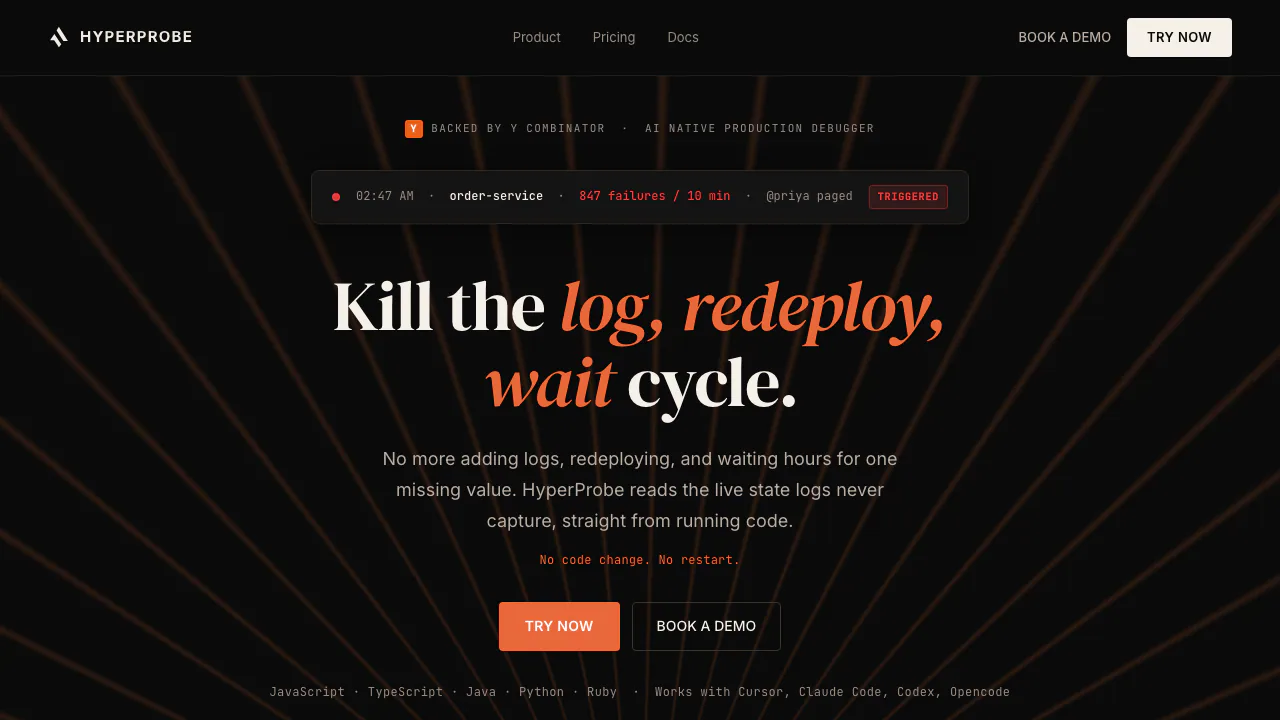
HyperProbe is een AI-native production debugger, gesteund door Y Combinator. Backendteams kunnen van alert naar bevestigde root cause gaan met read-only virtuele breakpoints in draaiende productiecode, zonder redeploy of herstart.
Wat is HyperProbe? In gewone taal
HyperProbe beantwoordt: welke waarde hadden variabelen op het moment van falen, als logs dat nooit vastlegden?
In plaats van log → CI/CD → redeploy plaatst een probe een snapshot op echte traffic en verdwijnt weer. Geen thread-pauze, geen gebruikersimpact.
Het is een niet-blokkerende debugger voor productie, bestuurbaar via MCP door coding agents (Cursor, Claude Code, Codex, Opencode).
Problemen die het oplost
Stille write failures, stack traces ver van de oorzaak, geslikte exceptions, race conditions, API-drift bij derden, AI-code zonder runtime-bewijs.
Probes en veiligheid
Read-only, non-blocking, TTL/rate limit/hit expiry, PII-redactie in de agent, onveranderlijk auditlog.
Runtimes: JavaScript, TypeScript, Java, Python, Ruby.
AI on-call workflow
PagerDuty, Datadog, Slack → plan → probe → capture → bevestigde RCA.
Prijzen (september 2026)
Facturatie per service, onbeperkte probes/captures.
- Free: $0, 1 service, managed cloud, 7 dagen historie, MCP inbegrepen
- Professional: $99/service/maand ($79 jaarlijks, min. 3 services)
- Enterprise: maatwerk, self-hosted/VPC, approval gates
Zie pricing.
FAQ
Redeploy nodig om te debuggen?
Nee. SDK injecteert probes in-process.
Limiet op probes?
Nee — betalen per geïnstrumenteerde services.
Volledig in eigen infra?
Ja, Enterprise in uw VPC.
Officiële bronnen
Installation and first capture
Paste one prompt into your coding agent with the installation guide. The agent installs the in-process SDK, wires your entrypoint, enables source maps, and registers the MCP server. Official docs target 15 minutes to first capture. Architecture: SDK agent inside your service plus a broker/control plane (managed or self-hosted).
Integrations: PagerDuty, Datadog, Slack for alerts; Cursor, Claude Code, Codex, Opencode via MCP for agent-driven debugging; VS Code extension for manual probes.
Comparison: with vs without HyperProbe
Without HyperProbe, engineers grep logs, add print statements, wait for CI/CD, redeploy, and hope the failure reproduces—often 2+ hours for a one-line fix. With HyperProbe, the agent locates the frame, places a probe in background, captures on next matching request, and confirms RCA in under 10 minutes in published examples—without redeploy cycles.
More FAQ
What counts as one service?
One application with the SDK installed. Forty Kubernetes pods still count as one service. HyperProbe does not bill per host, container, traffic volume, or seat.
Can we start managed and move to self-hosted?
Yes. The SDK is identical; self-hosted changes where the control plane runs, not your instrumentation.
Which alert sources are supported?
PagerDuty, Datadog, and Slack per the product website. The agent reads logs and distributed traces to plan probe placement.
Does HyperProbe replace observability tools?
No. It complements logs and traces by capturing variable state those signals miss—especially silent failures and logic bugs without exceptions.
Vergelijkbare tools
AI-codering en ontwikkelaarstools →
PR LensFreemium
Begrijp architectuur en datastroom voordat je de diff leest.
MonidFreemium
Vind, controleer en gebruik tools vanuit één saldo.
Kilo CodeFreemium
Een open-source codeagent voor IDE, terminal en cloud
RevolteFreemium
Agentgestuurde softwarelevering van opdracht tot controleerbare wijziging.
Visual Studio CodeFreemium
Uitbreidbare code-editor met Copilot-suggesties, chat en agents