
Kilo CodeFreemium
An open-source coding agent for IDE, terminal and cloud workflows
Revolte: AI Software Development Tools for the Full Delivery Lifecycle
Agentic software delivery from engineering intent to reviewed code and production workflows.
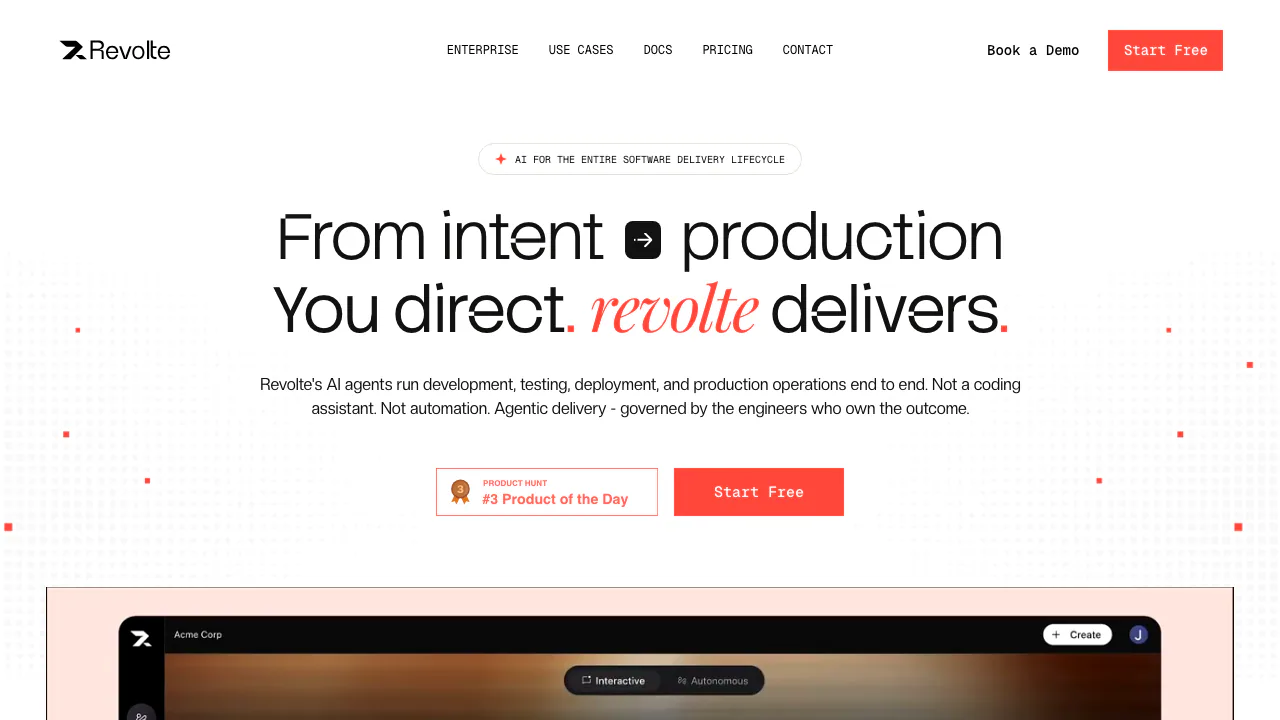
Revolte is an AI software engineering platform for teams that want more than code completion. Its agents can move a defined engineering task through planning, repository-aware implementation, tests, review artifacts, pull requests, deployment workflows, and production visibility. Engineers still set the intent, approve plans, inspect diffs, and decide what ships.
What Revolte handles beyond code completion
Most AI software development tools focus on suggestions inside an editor. Revolte is designed around a larger delivery loop. A task can begin as an idea, an existing repository change, or a Jira ticket. The platform creates an execution plan, works in an isolated cloud sandbox, edits and tests code, and prepares artifacts that a developer can review.
The product is suited to greenfield applications, focused feature work, bug fixes, refactoring, modernization, test coverage, and selected production-engineering tasks. It is not a substitute for architecture ownership or release accountability: the official workflow deliberately keeps people at planning, review, and merge checkpoints.
Choose an interactive session, Jira workflow, or CLI
For a first project, the shortest route is an Interactive session. Sign up, describe the desired outcome and constraints, choose the sandbox resources, then inspect the files, Diff view, test results, and Live Preview. If the session began without a repository, connect GitHub before committing and pushing the work. The official Interactive Chat walkthrough shows the current screens and sequence.
Teams with prepared backlog items can use Autopilot. Connect Jira and a Git provider, import project context, commit the Revolte configuration, map ticket statuses, choose a target branch, and trigger a run from Jira. The agent prepares a plan and changes in its sandbox, then opens a pull request for the team to review. CLI workflows keep similar work closer to the terminal.
Review the result before release
A Revolte sandbox is an isolated, disposable cloud environment scoped to one conversation or automated run. It can clone a branch, install dependencies, edit files, run commands, and execute tests without touching the developer's local machine. Code and file-change views make the work inspectable while the sandbox is running.
There is an important persistence limit: an unlinked fresh-project sandbox has no remote repository for an automatic draft commit. If it idles out before being linked or committed, its changes can be lost. Connect a repository or save the work before stepping away. A passing test suite is also not a release guarantee; review the plan, diff, pull request, preview, infrastructure changes, and deployment conditions.
Free plan, credits, and cloud costs
The current Revolte pricing page presents a hard-capped free tier with no credit card, 20 AI credits, one project, two apps, and one preview. Paid plans increase credits and workspace capacity, while Enterprise uses custom terms. Revolte describes pricing as service or outcome based rather than per seat, and meters AI credits separately from cloud consumption.
The same official pricing page contains older FAQ text that conflicts with its current plan cards, so this entry does not treat the legacy “Pro” price or older overage wording as current. Check the live page, currency, billing cycle, cloud region, taxes, and spend cap before budgeting production use.
Code, data, and governance checks
The Terms of Service say users retain ownership of submitted content and applications, while granting Revolte a limited license to process that content to operate, maintain, improve, secure, and provide the service. The terms also restrict uploading listed financial, identity, health, or similarly regulated sensitive data unless a separate agreement permits it.
The Trust Center states that stored data is encrypted at rest, traffic is encrypted in transit, and customer data is not used to train models. However, that page contains internally inconsistent statements about repository-code access and SOC 2 status. Before connecting proprietary repositories or regulated workloads, ask Revolte to confirm current access scopes, retention, subprocessors, certification evidence, data residency, and the exact deployment model in writing.
Official resources
- Revolte documentation — onboarding, workflows, sandboxes, and current product behavior.
- Pricing and usage plans — live quotas, credits, cloud meters, and enterprise options.
- Contact and technical support — product questions, demos, support, and security reports.
- Privacy policy — personal-data categories, purposes, service providers, and user rights.
Frequently asked questions
Is Revolte an AI coding assistant?
It includes coding-agent capabilities, but its verified scope is broader: planning, repository work, tests, pull requests, deployment workflows, and runtime visibility. It is best evaluated as an agentic software-delivery platform with human checkpoints.
Can I try Revolte for free?
Yes. The live pricing cards show a hard-capped free tier that does not require a card. Limits and paid rates can change, so verify the current pricing page before starting a long-running project.
Does Revolte deploy code without review?
The documented flows expose plans, diffs, artifacts, pull requests, and previews for human review. Automation depends on the workflow configuration, branch rules, approvals, and deployment setup; teams should keep their normal protected-branch and release controls.
Is proprietary source code safe to connect?
Do not rely on a marketing badge alone. Review the terms, privacy policy, requested integration scopes, retention rules, model-training statement, and the Trust Center inconsistencies. For sensitive code, obtain written confirmation that matches your repository and deployment setup.
Related tools
AI Coding & Developer Tools →
PR LensFreemium
See a pull request’s architecture and data flow before reading the diff.
Mastra FactoryFreemium
A shared software factory for coding agents and human reviewers.
MuleRunFreemium
AI agents, cloud workspaces, and repeatable workflows
Z.aiFreemium
A GLM-powered web assistant for chat, files, slides, apps and agent tasks.
Visual Studio CodeFreemium
An extensible code editor with Copilot suggestions, chat and agents