

PR LensFreemium
See a pull request’s architecture and data flow before reading the diff.
Kilo Code AI Coding Assistant
An open-source coding agent for IDE, terminal and cloud workflows
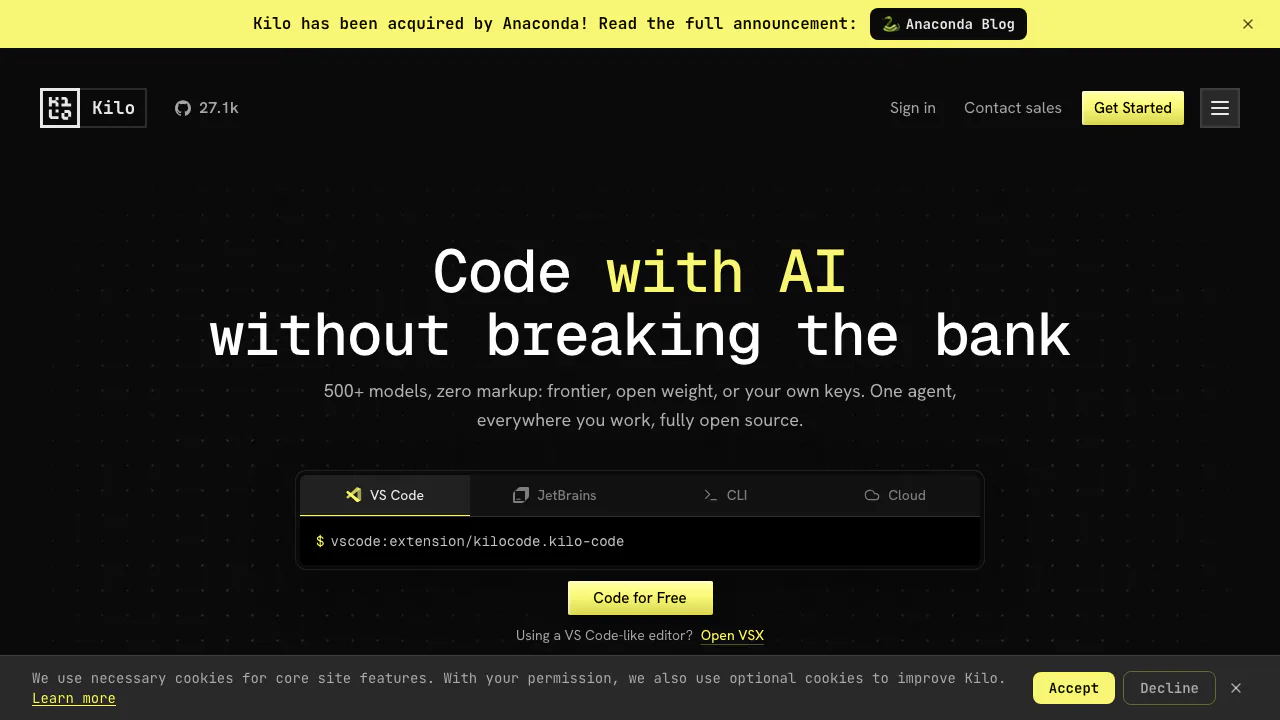
Kilo Code is an open-source AI coding assistant for developers who want one agent across an IDE, terminal, and cloud workflow. It can inspect a repository, generate or edit files, explain code, refactor, debug, run terminal commands, automate browser steps, and provide inline completions. Its strongest differentiator is model choice: use Kilo's hosted gateway, bring an API key, or connect a local model instead of being tied to one vendor.
What Kilo Code helps you accomplish
Kilo is built for tasks that require more than a pasted code snippet. Code mode can implement a change across files, Architect mode can structure a plan before edits begin, Ask mode can explain a codebase without changing it, and Debug mode focuses on tracing failures. Custom agents let a team encode repeatable instructions for jobs such as documentation, security review, or framework-specific work.
The agent can read and modify project files, search repository context, and run commands. That makes it useful for feature work, refactoring, test generation, documentation updates, bug investigation, and repetitive maintenance. Because those actions can affect a real workspace, review the proposed diff and command output before accepting a result.
A practical first workflow
- Follow the official installation guide for VS Code, a compatible editor, JetBrains, or the CLI.
- Connect Kilo's built-in provider, add your own provider credentials, or configure a local endpoint.
- Open the repository and describe a bounded outcome, including relevant files, constraints, and the test command.
- Let Kilo inspect context and propose edits. Keep approvals enabled when you want to review file or terminal actions.
- Inspect the diff, run the project's tests, and verify behavior before merging.
For terminal-first work, the documented install command is npm install -g @kilocode/cli. The CLI guide also covers interactive approvals and autonomous runs.
Model choice, BYOK, and local inference
Kilo advertises access to more than 500 hosted models through its gateway. You can also connect provider keys directly or use Ollama, LM Studio, and compatible local endpoints. This flexibility is valuable when cost, latency, model capability, or data routing matters more than a single default model.
A local model is not automatically the best model for every agent task. Hardware requirements, context limits, tool support, and output quality vary. Start with a small repository task and verify the exact model before allowing broader edits. The local-model guide also notes that account access, remote MCP servers, telemetry choices, and cloud features can create separate network paths even when inference itself is local.
Pricing and data considerations
As verified on September 2, 2026, the individual platform plan is free, while model inference and cloud compute are billed separately. Auto Free, local models, and BYOK can avoid a paid Kilo inference plan. Kilo Gateway is pay as you go at provider rates, Kilo Pass starts at $19 per month, Teams is listed at $15 per user per month, and Enterprise pricing is custom. Credit purchases carry a separate 5% processing fee. Check the current Kilo pricing page before committing, because models, limits, and prices can change.
Do not treat “open source” as a blanket privacy guarantee. Hosted requests are handled according to the selected provider and service path. Kilo warns that Auto Free may use upstream providers that log prompts and outputs and use them to improve services. Review the privacy policy, provider terms, and workspace permissions before sharing proprietary code or secrets.
Who Kilo Code fits
Kilo is a strong fit for developers who want an inspectable agent, broad model choice, IDE and CLI access, or a path to local inference. It also suits teams that want shared agents and governance options. It may be a less direct fit if you prefer a single-model assistant with almost no setup, or if your environment forbids agents from reading files or executing commands.
Kilo Code FAQ
Is Kilo Code free?
The individual platform is free, and Kilo documents ways to use free, local, or BYOK models. Hosted inference and cloud compute can still create usage charges, so “free” depends on the model and service path you select.
Which editors and platforms are supported?
Official documentation covers VS Code and compatible forks, JetBrains IDEs, and the Kilo CLI. Cloud agents, mobile apps, Slack, and code-review workflows are also part of the wider platform, with different network and billing requirements.
Can Kilo Code run with local models?
Yes. Kilo documents Ollama, LM Studio, Atomic Chat, and OpenAI-compatible endpoints. Local inference can keep model prompts on infrastructure you control, but connected services and telemetry need separate review.
Does Kilo Code send code for model training?
That cannot be answered with one universal yes or no because routing depends on your selected provider. Kilo specifically warns that some Auto Free providers may log prompts and outputs for service improvement. Check both Kilo's policy and the chosen model provider's terms.
Official resources and developer community
- Kilo Code documentation — setup, models, permissions, platforms, and troubleshooting.
- Kilo Code on GitHub — MIT-licensed source, issues, releases, and contributions.
- Official Discord community — community help and product discussion.
- Kilo service status — current service incidents and availability.
Related tools
AI Coding & Developer Tools →
Mastra FactoryFreemium
A shared software factory for coding agents and human reviewers.
RevolteFreemium
Agentic software delivery from engineering intent to reviewed code and production workflows.
MuleRunFreemium
AI agents, cloud workspaces, and repeatable workflows
Z.aiFreemium
A GLM-powered web assistant for chat, files, slides, apps and agent tasks.
HyperProbeFreemium
AI-native production debugger that captures live variable state without redeploying