

DevPitFree
Keep coding sessions, task boards and call costs together on your desktop.
Octri: API Documentation Generator, SDKs and MCP
Generate API docs, SDKs and agent tools from one specification.
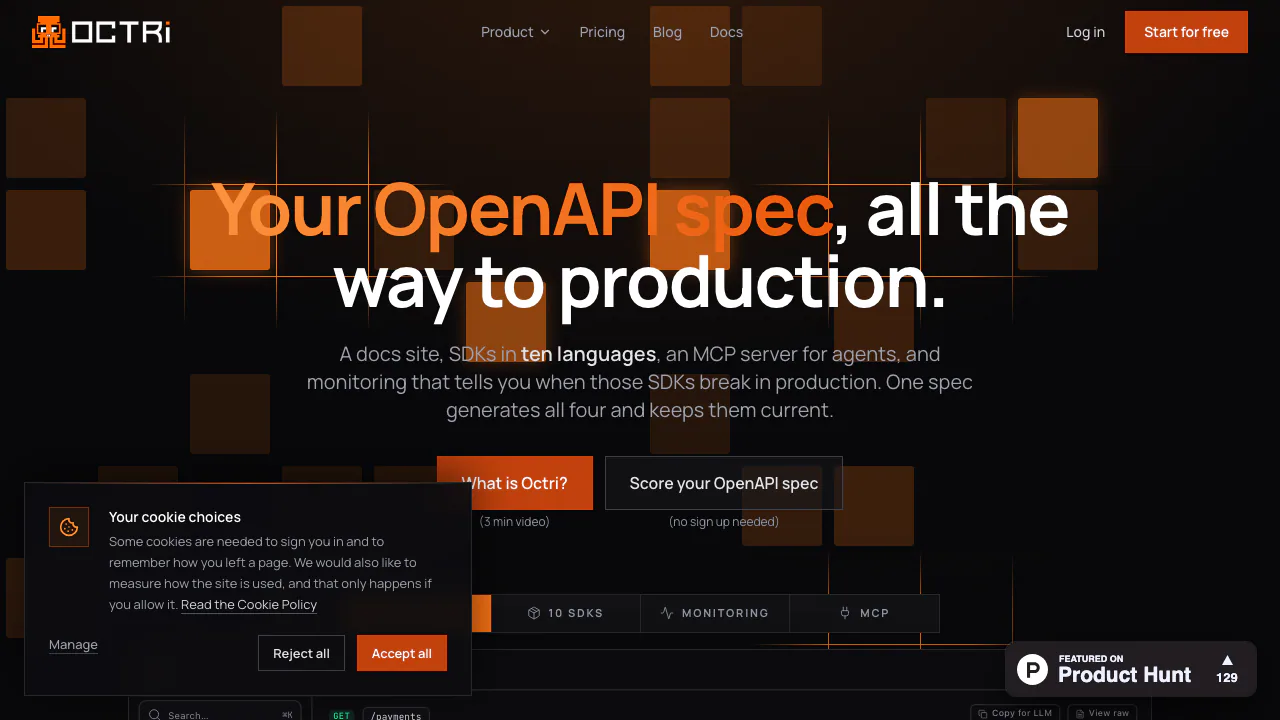
Octri is an API documentation generator and developer platform for teams that already maintain an API specification. It connects editable reference pages, client SDKs, MCP access and production monitoring to the same source.
What does Octri do, in plain English?
Think of your API specification as a technical instruction sheet. Octri turns that sheet into a website people can read, software libraries developers can install, and tools an AI assistant can use to work with the API. Monitoring adds visibility into problems after those libraries reach users.
It is useful for SaaS companies, API providers and small teams maintaining several client integrations. You still need a real API and a usable specification; Octri does not replace the service implementation or the review of generated explanations. You can use individual modules without activating all four.
From your specification to reviewed documentation
API Studio accepts a specification file or a connected GitHub repository. It can draft endpoint explanations, render nested schemas and place request examples beside the reference. You can edit the resulting page directly and add your own MDX guides for authentication, onboarding or a multi-step integration.
A practical first run is:
- Import your specification and inspect endpoint names, authentication and request/response schemas.
- Generate the reference and correct descriptions against the actual API.
- Test a representative endpoint with the live request console, including an error case. Requests originate in the reader's browser, so your API's CORS settings matter.
- Configure publishing and, if needed, SDK languages and registry connections.
- Review the rebuilt draft and change diff before approving publication.
GitHub sync is available on every plan. A spec change can start a rebuild, but the official workflow retains an approval step before new SDK versions reach registries.
Generate client libraries in ten languages
SDK Studio supports TypeScript, Python, Go, Java, Kotlin, Ruby, PHP, Rust, Swift and Dart. Method names, endpoint exclusions and language settings help shape the client before it is built. Package publishing connects the result to the ecosystems your users already use.
The platform supports ten languages overall; your plan determines how many you can activate. Custom SDK code is listed from Growth upward. Review the generated client against your API before shipping it, particularly authentication and unusual response schemas.
Let agents read the docs and call selected endpoints
Octri's MCP server provides seven documentation tools and can expose included API endpoints as executable tools. Claude, Cursor and other MCP clients can therefore read published reference material instead of relying only on model memory.
Documentation access works with the project ID. Executable calls require the appropriate API credentials, which stay on the machine running the server. Choose the target environment, credential scope and endpoint exclusions deliberately; a real API call can have real effects.
Observe failures and understand the data flow
Monitoring covers generated SDKs and supported backend packages, with logs, grouped issues, traces, uptime checks and alerts. It is off by default. Octri describes redaction on the client and again during ingestion, which helps explain what is collected without implying that every application payload is harmless.
The privacy policy says relevant specification text is sent to a model provider for drafting; questions and matching passages are sent for Ask-the-docs, and documentation is processed for search embeddings. Octri states that neither it nor those providers train models on this content. This is a hosted processing workflow, not entirely local generation.
Free limits and when to upgrade
Checked on October 6, 2026, the official monthly USD prices exclude tax:
- Free: one project, one SDK language, 50 endpoints, 100 MB of monthly monitoring and 100 one-time AI credits.
- Starter: $49/month, including two SDK languages.
- Growth: $99/month, including four languages, versioning and custom code/components.
- Business: $249/month, including all ten languages and white-label options.
- Enterprise: custom pricing; the generator and documentation renderer can run in your infrastructure.
One endpoint generation or one Ask-the-docs answer consumes one AI credit. Manual editing, SDK builds and hosting are outside that credit system. Consult the current plan comparison for quotas and add-ons.
Custom domains and GitHub sync are included on Free.
Frequently asked questions
Is Octri free?
Yes, within the Free limits above. Its 100 AI credits are granted once, not renewed monthly. When they run out, AI generation and Ask-the-docs stop, while published documentation, SDK building and monitoring continue.
What specifications can I import?
The official list includes OpenAPI 3.0/3.1, Swagger 2.0, Postman and AsyncAPI in JSON or YAML. Check imported schemas rather than assuming every converted specification is complete.
Do edits survive regeneration?
Octri says manual field edits are retained while untouched generated fields can be refreshed. Review the draft and diff when the specification changes.
Official resources
- Octri documentation: setup, SDK language guides and MCP configuration.
- Octri GitHub: public packages and SDK issue reporting.
- Product and billing support: official help channels and troubleshooting.
Related tools
AI Coding & Developer Tools →
ReviuFreemium
Review agent-written code, return line comments and finish Git work in a native desktop workspace.
AutonomyAIContact

FlootFreemium
Build and publish full-stack apps from your AI assistant
Mastra FactoryFreemium
A shared software factory for coding agents and human reviewers.
PR LensFreemium
See a pull request’s architecture and data flow before reading the diff.