

EdgeeFreemium
Route coding agents, compress tokens and track model costs.
UnoRouter: Unified AI API, Free Models and Chat
One key for multiple AI models, with provider routing and browser chat
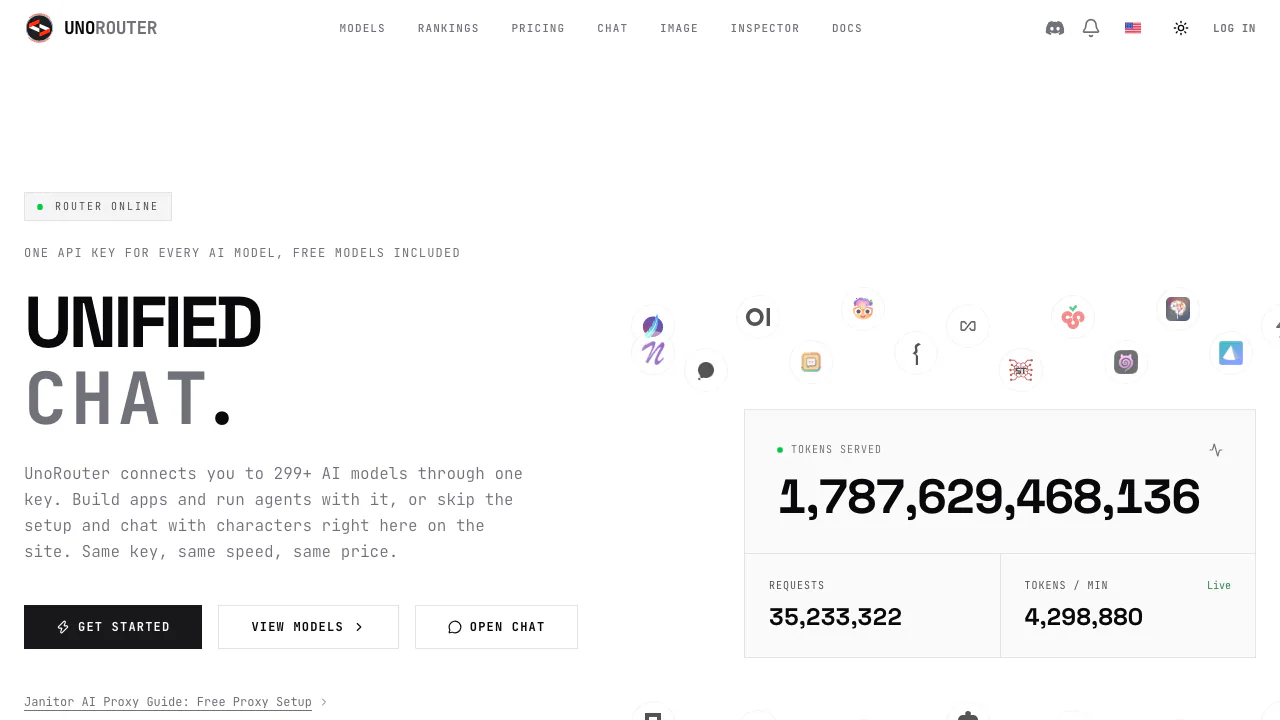
UnoRouter is a unified AI API for accessing models from multiple providers with one key. It also includes browser character chat, so individual developers and people exploring AI conversations can start through either an API client or the website. The useful distinction is between a common connection format and the changing capabilities, costs and data rules of each model route.
What does UnoRouter actually do?
Think of UnoRouter as a switchboard between your application and AI model providers. Your client sends a prompt to its endpoint, UnoRouter forwards the request through an eligible provider, and a model response comes back. Changing the model ID lets a compatible application try another model without rebuilding every provider integration.
The hosted API is the main service. The built-in chat is a separate way to use it: free models are already connected, with characters, personas, lorebooks and imported character cards. This makes it useful for model experiments and personal chat workflows, while the current business-account and data-processing conditions need separate attention.
Connect a client and send a first request
The official API quickstart identifies the three values you need: a key, an endpoint and an exact model ID.
- Register and create a key on the Tokens page. Save it securely when shown; it appears only once.
- Set an OpenAI-compatible client's base URL to
https://api.unorouter.com/v1and supply your UnoRouter key. - Copy a current model ID from the catalogue. Use an ID ending in
:freeif you want a free route. - Send a short prompt and check the response before adding a long conversation or agent workflow. Direct Chat Completions requests go to
https://api.unorouter.com/v1/chat/completions. - Check the model's context window, input/output rates and capability badges. Free access does not imply support for vision or tool calling.
Keys can have spending caps, expiry dates and model/IP allowlists. Native-protocol clients such as Claude Code or Gemini CLI use different endpoint conventions; follow their individual guides rather than assuming every client needs /v1.
Janitor AI proxy setup and browser roleplay
Janitor AI expects the full https://api.unorouter.com/v1/chat/completions address in its Proxy URL field. Add a configuration in API Settings with a name, exact model ID, that full URL and your UnoRouter key. Save the configuration and settings, then hard-refresh before testing. If the client offers to append /chat/completions, leave that option off when using the full address. The Janitor AI integration guide explains the fields and common failures.
For a simpler first trial, use the website's free-model chat without an account or key. The chat documentation covers character cards, group conversations, custom providers and backups. History is stored in your browser, so understand the backup options before clearing browser data.
How routing and failover affect availability
Automatic routing selects the cheapest live provider group for the requested model and can try another provider when a route fails. Group pinning restricts eligible providers for particular models. It gives you more control, but failover stays within that chosen set: a pinned route can fail even while another provider still serves the model.
Free capacity depends on both UnoRouter's limits and upstream quotas. Paid models have no UnoRouter-imposed RPM, TPM or concurrency cap, but upstream capacity still applies. Neither automatic failover nor paid access guarantees an uninterrupted response.
Free models, prepaid balance and weekly subscription credit
Checked November 13, 2026 on public USD pricing. Models ending in :free use only free providers and never draw down your balance. The default platform cap is one request per minute per user per free model; upstream limits, daily pool budgets and request-size caps may also apply.
Paid models use prepaid credit, charged at the model's input/output token rates or a per-call price. The public top-up page starts at USD 1, with payment-method minimums determined at checkout. Purchased balance does not expire.
Optional subscriptions work differently. Starter is USD 20/month, advertised with USD 40 monthly credit delivered at USD 10/week. Pro is USD 50/month with USD 100 advertised monthly credit, delivered at USD 25/week. Scale is USD 100/month with USD 200 advertised monthly credit, delivered at USD 50/week. Unused weekly allocations do not roll over. Plans also reduce or remove platform waiting between free-model requests; provider limits remain separate. Check the current pricing and allocation rules before choosing a plan, including checkout taxes and conditions.
Understand where prompts go before using real data
Browser-local history does not mean local inference. Prompts still reach the provider serving the model. UnoRouter says it does not train its own models on your prompts or responses, while upstream providers may retain or train on inputs. The privacy policy explains provider-dependent processing, international transfers and consent requirements. Automatic routing should not be read as an EU-only processing guarantee.
The current Terms and Conditions say business customer accounts are not currently offered. Output ownership depends on the specific model's terms. Public source code therefore does not establish a universal commercial output license or enterprise data-processing agreement.
Frequently asked questions
Are free models unlimited?
No. The :free suffix identifies a zero-cost route, not unlimited throughput. Platform frequency caps, provider capacity and request-size limits can still apply.
Do I need an account and key?
API and external-client requests require your key. Built-in free-model chat works without registration or a key; this does not make the API anonymous.
Why is my request rate limited or unavailable?
For 429, wait for the Retry-After period. For 503, read the error: get_channel_failed may indicate unavailable providers or pinned groups, while model_not_found requires correcting the model ID rather than repeated retries.
Are prompts kept private from providers?
No. The provider must receive input to generate a reply. Local chat storage, UnoRouter's own training policy and each upstream provider's data rules are separate considerations.
Official resources and developer community
- Platform documentation: API keys, models, billing and errors.
- Model status: current availability by model.
- Official GitHub: gateway and chat source; check each repository's license.
- Official Discord: integration help and community updates.
Related tools
AI Model APIs & Infrastructure →
FastRouterFreemium
One API for model access, routing and spending visibility
teai.ioFreemium
Connect multiple AI models through one API and a shared credit balance.
Levanto SageFreemium
Classify messages and return decisions your software can use.
ClickFreemium
Run agents with your model keys, tools and durable sessions
JevModelFreemium
Turn text or JSON into labels, scores and probabilities with Jev.