

Bolt.newFreemium
Build websites and apps in the browser by chatting with AI.
Lovable AI app builder guide
Build and deploy full-stack web apps with natural language.
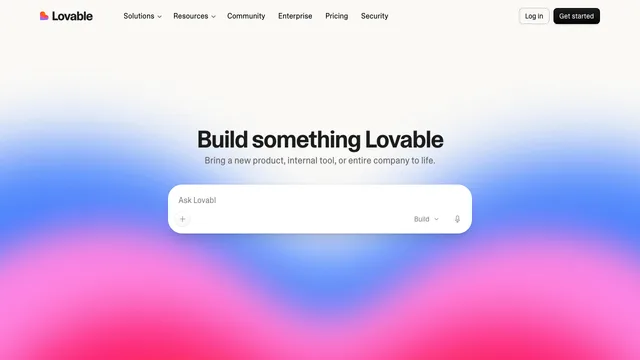
Lovable AI is a full-stack AI development platform for turning a natural-language product brief into a working web application with editable code. It combines an AI agent, visual editing, a browser preview, backend services, deployment and GitHub synchronization. It is useful for founders, product managers, designers, marketers and developers who want to move from an idea to a testable product without assembling the initial stack manually.
The platform can reduce setup work, but it does not remove product, engineering or security decisions. A good evaluation should consider what Lovable builds, how credits work, where the code and data live, which mobile options exist and what must still be reviewed before a production launch.
What Lovable AI builds and who it suits
Lovable focuses on websites and web applications: landing pages, internal tools, dashboards, customer portals, marketplaces, SaaS prototypes and data-driven products. A non-developer can describe screens and behavior in ordinary language, while an experienced developer can inspect the generated code, connect services and continue the project in a normal Git workflow.
It is strongest when the desired workflow and data model can be explained clearly. It is less suitable as a one-click substitute for engineering on regulated, safety-critical or unusually complex systems. Teams still need to define requirements, test edge cases and decide how authentication, data access and operating costs should work.
Lovable AI tutorial: from brief to first deployment
Start with a short product brief that names the users, their main task, required pages, data and visual direction. Ask for a small first version instead of every feature at once. Review the generated interface, then iterate in focused steps such as “add email sign-in,” “create an admin role,” or “make the checkout usable on mobile.”
Use the preview and visual editor for layout changes, but describe business rules explicitly in chat. Test each major change before asking for the next one, because a long sequence of broad prompts can make defects harder to isolate. Once the core flow works, connect a backend, add realistic test data, verify empty and error states, and publish to a temporary URL before attaching a production domain.
Lovable AI app builder features and technology
Lovable can generate the frontend and connect backend features such as a database, authentication, storage, server-side functions and third-party APIs. Teams may use the built-in Lovable Cloud backend or connect Supabase for PostgreSQL, authentication, storage, realtime features and serverless functions.
New Lovable projects created from May 13, 2026 use TanStack Start with server-side rendering. Older projects use React and Vite with prerendering on public deployments, and eligible projects can be upgraded. Tailwind is used for styling. The practical implication is that generated projects are real codebases, but developers should confirm the stack of the specific project before planning libraries, deployment or migrations.
Lovable GitHub sync, export and code ownership
Lovable supports export and two-way synchronization with GitHub. Changes made in Lovable can reach the connected repository, and changes pushed to the active branch can sync back. This creates an external backup, enables pull requests and code review, and lets a team clone the project into a local IDE or deploy through another provider.
There are workflow limits. Lovable currently exports a project to a repository rather than importing an existing repository into Lovable, and the integration edits one active branch at a time. Renaming, moving or deleting the linked repository can break synchronization. Lovable states that creators own their projects, code, stored customer data and generated output, subject to third-party rights. Keeping an independent Git history remains the safest portability practice.
Lovable AI pricing, free credits and operating costs
As checked on August 31, 2026, the free workspace includes a daily grant of five build credits, capped at 30 per month, plus 20 monthly Cloud credits and four credits for trying AI features inside a deployed app. Default Mode uses a variable number of credits based on task complexity; Plan Mode uses one credit per message. Paid plans add a shared workspace balance and included grants.
Credits can be consumed by building, running a deployed app and powering AI features used by the app’s own visitors. Small or new apps are often covered by the included hosting grant, while larger traffic or heavier workloads may consume additional balance. Plans are workspace-based, credits are shared, and adding members does not create a separate per-seat charge. Check the official pricing page before purchase because allowances, regional rules and plan terms can change.
Lovable mobile apps, SEO and deployment limits
Lovable builds web applications, not React Native projects. It can create responsive mobile-friendly sites, and an installable experience can be delivered as a Progressive Web App or wrapped with a tool such as Capacitor for app-store submission. Lovable also offers native iOS and Android companion apps for prompting and reviewing projects, but detailed code review and visual editing remain more practical on a larger screen.
For search visibility, current TanStack Start projects use server-side rendering, while older React and Vite projects use prerendering on public URLs. That helps crawlers receive rendered content, but technical rendering is only one part of SEO. Teams must still write useful page copy, metadata, internal links, structured content and accessible navigation.
Projects can run on Lovable Cloud, use a hybrid setup or be moved to external infrastructure. Code can be deployed through providers such as Netlify or Cloudflare, and data can be migrated to services a team controls. The Lovable editor and AI agent themselves remain managed services and cannot be self-hosted.
Lovable AI security and production checklist
Lovable includes scanners for row-level security policies, database configuration, application code and dependency vulnerabilities. It can detect pasted API keys and guide users toward secret storage. Automated scans and fixes are useful, but Lovable explicitly says they do not replace a security review appropriate to the app’s risk.
Before launch, test sign-up, password reset, account deletion, authorization between user roles, database row-level security, file permissions, rate limits, payment webhooks, error handling and backups. Never place private keys in browser code. Review third-party API terms, data retention, privacy disclosures and regional compliance needs. For sensitive or critical software, add human code review, penetration testing and operational monitoring.
Is the Lovable AI app builder the right choice?
Choose Lovable when speed to a working web product, editable code, integrated backend options and GitHub portability matter more than selecting every infrastructure component from day one. It can be particularly effective for prototypes, internal tools, customer portals and early SaaS products that need rapid iteration.
Consider another workflow when the project must begin from a mature existing repository, requires native React Native output, depends on an unsupported runtime, or demands infrastructure that cannot pass through a managed editor. Compare the complete cost of credits, hosting, external APIs, database growth and developer review—not only the subscription price.
Lovable AI FAQ
Is Lovable AI free?
Yes. The free workspace has limited daily and monthly grants for building, Cloud use and in-app AI. These allowances can change, so verify the current pricing page before planning a project around them.
Can Lovable AI build a mobile app?
Lovable builds responsive web apps rather than React Native projects. A project can be made installable as a PWA or wrapped with Capacitor. The separate Lovable mobile client lets creators work on Lovable projects from iOS or Android.
Can Lovable import an existing GitHub repository?
The current Git sync workflow exports Lovable projects to GitHub and supports two-way synchronization afterward. It does not start by importing an existing repository into Lovable.
Who owns code generated by Lovable?
Lovable says the creator owns the project, code, stored customer data and generated output, subject to rights that may apply to underlying models or third-party material.
Does Lovable replace a developer?
It can remove much of the initial setup and make iteration accessible to non-developers, but production requirements, debugging, architecture, accessibility, security and operations still benefit from experienced review.
Can a Lovable app be hosted elsewhere?
Yes. GitHub synchronization and standard web technologies provide paths to external frontend hosting, a managed backend such as Supabase, or fully self-managed infrastructure. The Lovable editor itself is not self-hosted.
Related tools
AI Coding & Developer Tools →
ReplitFreemium
Build, test and deploy apps with an AI coding agent.
v0Freemium
Build editable full-stack web apps from prompts, screenshots and repositories with GitHub, databases and Vercel deployment.
Mastra FactoryFreemium
A shared software factory for coding agents and human reviewers.
PR LensFreemium
See a pull request’s architecture and data flow before reading the diff.
HyperProbeFreemium
AI-native production debugger that captures live variable state without redeploying