

v0Freemium
Build editable full-stack web apps from prompts, screenshots and repositories with GitHub, databases and Vercel deployment.
Replit AI app builder and coding agent guide
Build, test and deploy apps with an AI coding agent.
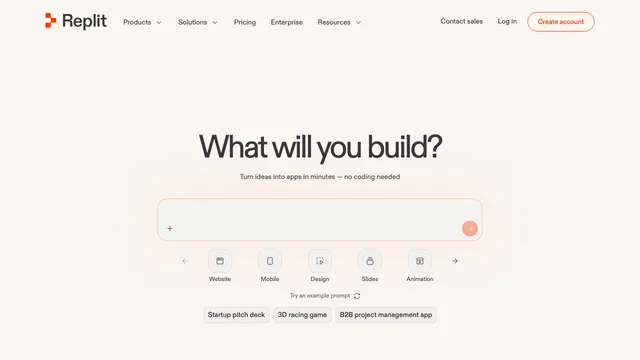
Replit AI is a browser-based development workspace where an AI agent can plan, write, test and deploy software from a natural-language request. It combines an editor, shell, preview, database, authentication, secrets, collaboration and cloud publishing. Beginners can build without starting from an empty repository, while developers can inspect and change the code at every step.
The useful question is not whether Replit can produce a first demo, but whether its workflow, effort-based AI billing and deployment model fit the complete life of the application.
What Replit AI builds and who it helps
Replit Agent can create websites, full-stack web apps, mobile apps, automations, agents, data visualizations and other artifacts. Typical uses include internal tools, booking systems, dashboards, customer portals, SaaS prototypes and small production services.
It helps founders and product teams validate an idea, students learn by editing working code, and developers automate setup or routine changes. A generated project still needs requirements, testing and security review. Projects with strict infrastructure rules, unsupported runtimes or unusually demanding performance may need a conventional local toolchain.
Replit Agent workflow from prompt to application
Begin with users, the main task, pages, data and external services. Ask Agent to plan the smallest useful version before adding every feature. Review the plan and let it build a checkpoint. Test the preview, inspect changed files and correct one problem at a time.
Use Plan Mode for reasoning before paid implementation, Design Canvas for visual exploration and Visual Editor for interface changes. Agent may test its own work in a browser, but a passing generated test is not proof that business rules are correct. Add realistic data, failure cases and role-based access before publishing.
Replit AI coding assistant, code and rollback
Unlike a chat-only assistant, Replit Agent works inside the project and can modify multiple files, run commands, install packages and fix test failures. Developers can continue with the normal editor and shell instead of accepting every suggestion.
Build Mode creates checkpoints that capture completed work. Checkpoints help compare or roll back application changes, but database retention and rollback depend on the plan and should not be treated as a complete backup strategy. Commit important code to external version control and maintain data backups for production.
Replit app builder database, authentication and integrations
Replit includes development databases, managed production PostgreSQL, object storage, user authentication and secrets. Agent can connect services such as Stripe or AI providers without placing keys in client code. Paid third-party model or API use can still be deducted from Replit credits at the provider’s public API rate.
The free Starter plan has fewer connectors and build capabilities than Core or Pro. Confirm data region, retention, export, integration permissions and service-specific charges before storing sensitive or high-volume workloads.
Replit deployment options and cloud costs
Replit can publish static sites, autoscaling apps, scheduled jobs and reserved virtual machines. Autoscale charges only while requests are being processed and becomes idle after inactivity; static publishing mainly uses outbound transfer. Production database, compute, requests and data transfer can all affect cost.
Starter includes one published app that expires after 30 days but can be published again and displays a Replit badge. For details, compare the official publishing costs. Set budgets and usage limits before a public launch, then monitor the Account usage dashboard.
Replit AI pricing and effort-based credits
As checked on August 31, 2026, Starter is free with daily Agent credits, a built-in database and one live project. Core is $20 per month, or $17 per month when billed annually, with two parallel agents, Plan Mode, unlimited workspaces and $20 toward powerful models. Pro is $100 monthly, or $95 when billed annually, with ten parallel agents, up to 15 collaborators and up to 28 days of database rollback.
Paid Agent work uses effort-based pricing: small fixes usually cost less than complex features, and even Plan Mode reasoning can be billable. The official pricing page and AI billing guide should be checked before purchase because allowances and model routing can change.
Replit collaboration, ownership and portability
Core supports up to five collaborators, while Pro supports up to 15 builders and 50 viewers under current plan information. Shared workspaces make reviews and live iteration easier, but roles and spending controls should be configured before inviting a team.
Generated code remains editable and can be moved through ordinary source control. Portability is stronger when the team keeps an independent repository, documents environment variables and tests deployment outside Replit before it becomes urgent.
Replit AI security and production checklist
Keep API keys in Secrets, enforce authorization on the server and review every database permission. Test registration, password reset, account deletion, tenant isolation, file access, payment webhooks, rate limits and error handling. Confirm backups by restoring them, not merely by seeing a checkpoint.
AI output is probabilistic, and Replit’s own pricing page warns that Agent may make mistakes. Regulated or sensitive software needs human code review, dependency scanning, privacy disclosures, logs, incident procedures and, where appropriate, penetration testing.
Is the Replit AI app builder a good choice?
Choose Replit when an integrated browser workspace, editable code, Agent-driven implementation and built-in publishing are more valuable than assembling separate development and hosting tools. It works well for learning, prototypes, internal tools and early products.
Choose another route when infrastructure must be fully self-managed from the start, the workload needs unsupported technology, or usage-based AI and cloud billing is harder to govern than a fixed toolchain. Compare the cost of Agent, deployment, database and external APIs together.
Replit AI FAQ
Is Replit AI free?
Starter is free and includes limited daily Agent use, a development database and one temporary published app. Full Build, Plan Mode, more connectors and additional publishing require a paid plan.
Can Replit Agent build a complete app?
It can create frontend, backend, data, authentication and deployment, but “complete” still requires human validation of requirements, security, performance and operations.
How does Replit Agent pricing work?
Paid work is priced by effort. More complex requests consume more credits, and some third-party AI services are charged at their public API rate.
Can Replit AI build mobile apps?
Replit lists mobile apps among supported project types. Store packaging, device testing and distribution requirements still need to be checked for the chosen mobile stack.
Does Replit own generated code?
Projects remain editable and can be placed in normal source control. Teams should review current service terms for ownership and keep an independent repository for portability.
Can a Replit app be hosted elsewhere?
Code can be moved, but portability depends on documenting the runtime, database, storage, secrets and integrations. Test an external deployment before relying on it as a recovery path.
Related tools
AI Coding & Developer Tools →
DeepSeekFreemium
Free AI chat, reasoning, web search, file analysis and coding with token-priced developer API access.
DevinFreemium
Autonomous coding agent for repository questions, code changes, tests, debugging, migrations and pull requests.
GitHub CopilotFreemium
AI coding assistance across editors, terminals, and GitHub workflows
CursorFreemium
An AI coding agent for understanding, editing, and shipping software
Mastra FactoryFreemium
A shared software factory for coding agents and human reviewers.