

Spira AIFreemium
Create branded content, review social posts, schedule publishing and learn from results.Pipio AI Avatar Video Generator Review
Create presenter videos with AI avatars, voices, and dubbing
What is Pipio?
Pipio is an AI avatar video generator for turning a written script into a presenter-led video without filming a human actor for every take. You choose a stock or custom digital presenter, assign a text-to-speech voice, enter the script, and render a lip-synced video. It is aimed at training, marketing, sales, explainers, and repeatable content production.
The platform also includes multilingual video dubbing and an API for working with digital actors, voices, and lip-synced video generation. Pipio's official terms identify https://pipio.ai as the governed website, so that is the canonical URL used here even though many marketing and policy pages appear on the “www” host.
pipio ai: Main features
- Stock AI avatars: Select a ready-made presenter and pair it with a script and synthetic voice.
- Custom avatars: Express Avatars support up to 1080p chest-up framing and include voice cloning. Studio Avatars support up to 4K, close-up or full-body framing, background removal, eye-gaze correction, and voice cloning.
- AI voice generation: Pipio provides text-to-speech voices in varied styles and languages. Its official Voices page says the stock library covers more than 40 languages.
- Voice cloning: A personal cloned voice is available as an add-on with an Express or Studio custom avatar; it is not described as a standalone free-plan feature.
- Video dubbing: Upload an existing video, transcribe and translate it, then create dubbed audio synchronized to the original timing and mouth movements. The current help article lists Chinese among the supported dubbing languages.
- Multiple formats: The editor supports 16:9, 9:16, and 1:1 aspect ratios for landscape, vertical, and square publishing.
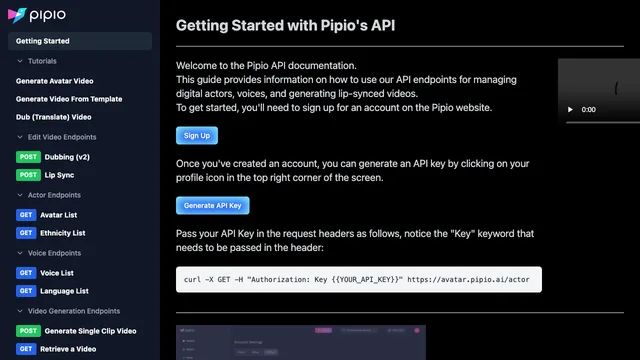
- API access: Developers can retrieve digital actors and voices and submit lip-synced video generation requests through Pipio's API.
Pipio: Pricing, free use, and credits
Pipio uses a freemium subscription model. The most recent publicly indexed official Voices page reviewed on August 20, 2026 advertises 3 free video minutes and a Premium plan at $16 per month. However, Pipio's live pricing page returned TLS/502 errors during review, while another official article mentions production from $20 per month. Treat $16 as an indexed marketing claim rather than a guaranteed checkout price, and confirm the current plan, tax, currency, and included credits inside Pipio before paying.
Pipio defines one credit as one minute of a normal project or one minute of video dubbing. Monthly credits refresh on the subscription renewal date and unused subscription credits do not roll over. Regular subscribers cannot buy ad-hoc credits according to the help center; they must change plans. Lifetime-account holders are the stated exception. Enterprise pricing is custom, and Pipio directs customers needing more than 3,000 credits per month to contact sales.
pipio ai: Commercial use and licensing
Pipio's help center says videos created with stock or custom avatars may be monetized provided the Terms of Service are followed. That permission is not unrestricted. Without Pipio's explicit written consent, stock avatars cannot be used in television broadcasts, promoted or paid social-media advertising, NFTs, spam, regulated or age-restricted product content, sensitive-topic statements, personal opinions presented as the avatar's own, or trademarks.
The terms grant access to the service through a limited, revocable license tied to an active compliant account. They do not present a simple, express assignment of all generated-output ownership to the user. For a high-value campaign, client deliverable, paid ad, television placement, or trademark use, obtain written clarification from Pipio rather than relying only on the general monetization FAQ.
Pipio: Consent and responsible use
Pipio requires explicit permission and recorded consent from every person shown in video or media submitted to train models for avatars or dubbed videos. Users may not upload someone else's video to create generative content without clear documented permission. The terms also prohibit impersonating another person or entity.
Custom avatars are therefore best created from footage you own and control. Keep model releases and consent records, especially when employees, clients, performers, or bystanders appear in source media.
pipio ai: Privacy considerations
Pipio's privacy policy says users may upload audio and video as generation data and may submit voice and video data to create an avatar. It also says personal information can be shared with service providers for operations such as hosting, analytics, payment processing, fraud detection, and feature improvement.
The Terms of Service grant Pipio a broad, perpetual, worldwide, sublicensable license to user content for operating, developing, providing, and improving the service and researching or developing new services. The privacy policy was last updated on March 23, 2022, says deletion requests may leave residual or archived information, and does not promise a short fixed retention period. Teams handling confidential faces, voices, or client footage should review the policy and request contractual data-handling terms before uploading sensitive material.
Pipio: Important limitations
- Custom avatars currently require approximately 5–8 minutes of recorded video; the help center says they cannot be created from one image and do not support non-human characters.
- Avatar emotions cannot currently be directly controlled, and interactive avatars are not supported.
- Dubbing guidance requires a mainly single-person video, limited background noise, 1080p resolution, a duration of 1–15 minutes, and MP4, MOV, or WebM input up to 50 GB.
- Editing the generated dubbing transcript or translation requires a Team plan according to the submission guide.
- Unused monthly credits expire, and standard subscribers cannot purchase one-off extra credits.
- Stock-avatar use has notable advertising, television, sensitive-topic, and trademark restrictions.
- Custom avatars are non-refundable after creation, while normal subscription refunds are described as available within 15 days only if credits remain unused.
- The live public pricing page was not reachable during this review, so current checkout terms need confirmation.
Who is Pipio best for?
Pipio suits creators and teams that need repeatable talking-head videos for training, product explainers, organic social content, or multilingual localization without repeatedly booking presenters and studios. It is less suitable for interactive digital humans, fictional or photo-only custom characters, fine-grained emotion direction, or campaigns that require unrestricted stock-avatar use in paid advertising.
pipio ai: FAQ
Is Pipio free?
Pipio advertises a free plan with 3 video minutes. Because the live pricing page was inaccessible during this review, verify the current allowance and export conditions after signing in.
How are Pipio credits calculated?
One credit equals one minute of a standard project or one minute of video dubbing. Monthly credits refresh on the renewal date and generally do not roll over.
Can I use Pipio videos commercially?
The help center says stock- and custom-avatar videos can be monetized if the Terms of Service are followed. Stock avatars cannot be used for television or promoted, boosted, or paid social ads without Pipio's written consent, and other content restrictions also apply.
Can I clone my own voice?
Yes. Pipio describes voice cloning as an add-on included with Express and Studio custom-avatar creation, rather than a general free voice-cloning tool.
Can I make a custom avatar from a photo?
No. Pipio's help center currently requires around 5–8 minutes of recorded video and says image-only and non-human custom avatars are not supported.
Do I need a person's consent?
Yes. Pipio requires explicit permission and recorded consent from every individual shown in source video or media used for generative avatars or dubbing.
Does Pipio support Chinese?
Yes. The language documentation lists Chinese variants for avatar voices and Chinese as a supported video-dubbing language.
What should privacy-sensitive teams check?
Review the broad user-content license, service-provider sharing, residual deletion language, and the privacy policy's March 2022 update date. Ask Pipio for current contractual security, retention, and model-training commitments before uploading confidential footage.
Pipio: Official sources
Related tools
AI Image & Video Generators →
TavusFreemium
Real-time conversational AI humans, custom replicas and async avatar video through one API
Elai.ioFreemium
Turn scripts, slides, URLs, and documents into interactive AI avatar videos
AI StudiosFreemium
DeepBrain AI's all-in-one platform for avatar video, dubbing and generative media
FavorePaid
Create an image, refine it, then turn it into motion in one workspace.
Rap Duo AIPaid
Turn two photos into an English rap duet with generated music and vocals.