
PipioFreemium
Create presenter videos with AI avatars, voices, and dubbing
Tavus Conversational AI Video API, Pricing & Replicas
Real-time conversational AI humans, custom replicas and async avatar video through one API
What is Tavus?
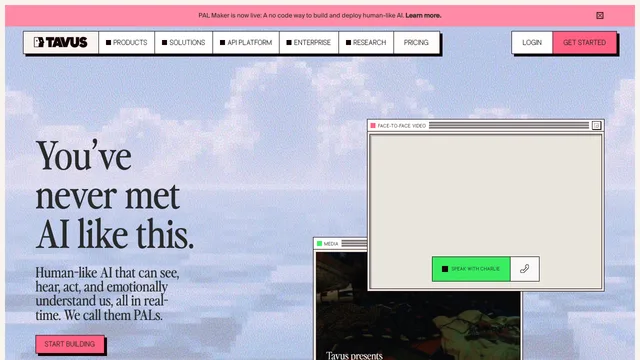
Tavus is a developer platform for building real-time conversational AI video agents. Its Conversational Video Interface (CVI) joins a configurable persona, a photorealistic replica and a live WebRTC room so an application can see, hear and answer a user through a face-to-face video experience. Tavus also has a separate asynchronous Video Generation API that renders a downloadable avatar video from a script or audio file.
This distinction matters. CVI is a two-way live session with perception, turn-taking, speech recognition, an LLM, text-to-speech and avatar rendering in one pipeline. Video Generation is a batch workflow that produces a static MP4-style asset; it does not create a live room. Developers can use either stock replicas or authorized custom replicas, embed the default Daily interface, build their own UI, or connect Tavus to supported LiveKit and Pipecat workflows.
Tavus conversational video and avatar features
- End-to-end CVI: Raven perception, Sparrow conversational flow and Phoenix rendering work with STT, an LLM, TTS and WebRTC. Tavus supplies the full stack, while advanced teams can replace configurable layers.
- Real-time visual perception: Raven can analyze expressions, gaze, objects, screen content and selected audio cues. Perception is optional and should be configured only when the application has appropriate user notice and a clear purpose.
- Natural turn-taking: Sparrow controls when the agent listens, speaks, yields and accepts interruptions. Voice isolation can reduce unwanted responses to nearby speech.
- Configurable personas: Set system behavior, context, greetings, objectives, guardrails, knowledge-base retrieval, persistent memories, function calls and pronunciation rules. An OpenAI-compatible custom LLM can be connected.
- Stock and custom replicas: Current plans include stock faces, while paid tiers add custom-replica slots. Tavus documents video-trained replicas from a short authorized recording and image-to-replica creation on eligible tiers.
- AI voice generation: CVI includes a TTS layer and supports Tavus voices plus configurable Cartesia or ElevenLabs voices. A custom replica can have a human-like voice and expression, but Tavus is not a standalone audio workstation.
- Async avatar video: Submit a replica with a script or hosted audio file, poll the job, then use its hosted or download URL. Async minutes are separate from CVI minutes.
- Multilingual delivery: The current pricing page lists 42+ languages. Exact language and voice availability can vary by the selected TTS engine.
- Embedding and meetings: Use Tavus's hosted Daily room, a custom web interface, or eligible Google Meet, Zoom, LiveKit and Pipecat integrations.
Current Tavus pricing and free limits
The prices and allowances below were checked against the currently visible Tavus pricing interface on August 20, 2026. The page source still contains older hidden plan tables, so outdated search snippets may show a different Free allowance or call the $59 plan “Starter.” The visible plans are:
| Plan | Current price | Main limits shown by Tavus |
|---|---|---|
| Free | $0 | 20 CVI minutes per month, 10 stock replicas, one concurrent session, a five-minute maximum session and no included async video minutes. API and no-code access are included, but watermark removal and custom-replica slots are not shown. |
| Starter | $22/month | 60 CVI minutes, one custom-replica slot, 10 stock replicas, one concurrent session, a five-minute maximum session, transcripts, no watermark and five async video minutes. The page explicitly says this tier has no pay-as-you-go coverage. |
| Builder | $59/month | 175 CVI minutes, three custom-replica slots, 25 stock replicas, three concurrent sessions, a 15-minute maximum session and 15 async video minutes. Overage is $0.35 per CVI minute and $1 per generated-video minute. |
| Growth | $397/month | 1,300 CVI minutes, seven custom-replica slots, 10 concurrent sessions, recordings, no conversation-duration limit and 50 async video minutes. Overage is $0.31 per CVI minute and $0.90 per generated-video minute. |
| Business | $975/month | 4,000 CVI minutes, 15 custom-replica slots, 15 concurrent sessions, priority support and onboarding, plus 250 async video minutes. Overage is $0.26 per CVI minute and $0.80 per generated-video minute. |
| Enterprise | Custom | Custom CVI and video allowances, custom concurrency, unlimited custom-replica slots in the comparison table, white-labeling, security/compliance options, zero-data-retention availability, SLAs and dedicated support. |
The same visible page is inconsistent about stock-replica counts: the Growth and Business plan cards say 100+, while the comparison table says 75+. Confirm the exact library inside the billing portal before purchasing.
The ongoing Free plan is the normal no-upfront-payment entry point, not a time-limited trial. Tavus's general terms also cover separately offered trials and promotions; those may roll into a paid subscription if not cancelled before the paid start date. Read the checkout terms for any promotion that requests payment details.
How Tavus minutes and overages work
CVI usage starts when the conversation creation request initializes a room and the replica begins waiting, not when a human participant finally joins. Each conversation has a 30-second minimum and is rounded to the nearest six-second increment. If nobody is present, Tavus says the conversation closes automatically after five minutes by default, although timeout settings can be changed. For request testing, the pricing FAQ says test mode can validate conversation creation without a usage charge.
Free and Starter stop at their included allowances because the current comparison table lists no extra-minute rate for those plans. Builder, Growth and Business support metered CVI overage at their displayed rates. Concurrency is a separate limit: if all simultaneous-session slots are occupied, another caller must wait until a slot becomes available.
Async Video Generation has its own minute pool and overage schedule. A generated video is a separate file-output product, so CVI minutes do not cover it. Tavus documentation also warns that async videos longer than about five minutes can show less natural or repeated gestures, while uploaded audio is capped at 10 minutes.
tavus lounge and grill: Commercial use, ownership and platform licensing
Tavus's Terms of Service grant compliant customers a license to use the platform for personal or internal business purposes and to integrate Tavus APIs into websites, applications and products used by end users. As between Tavus and the customer, the customer or its end users own submitted content, seed files and generated Media Files or Interactive Media Files. This supports commercial product use, subject to the agreement, payment and applicable law.
That ownership does not transfer the Tavus platform or its underlying models. A custom Customer Avatar is managed inside Tavus and is not downloadable, transferable or independently usable outside the platform. Generated media files may be downloaded where the product exposes that option. Tavus also receives a non-exclusive, worldwide, perpetual, royalty-free license to use customer content and generated files to fulfill requests, operate, maintain and improve its products and services.
Customers remain responsible for the accuracy, legality and downstream use of every input and output. Generated media must not impersonate someone without consent, falsely imply affiliation, violate publicity or privacy rights, or cause unlawful harm. Tavus does not promise that the service will be uninterrupted, error-free or that generated information will be accurate, so human review is still required for recruiting, healthcare, financial, legal or other high-impact decisions.
tavus lounge and grill: Real-person consent and replica requirements
Creating a digital replica is not permission to use another person's face or voice. Tavus's terms require the customer to obtain all necessary notices, rights, licenses, explicit biometric consents and written releases from people represented in uploaded or end-user data. The customer is also responsible for complying with privacy, biometric, publicity and data-protection laws in every market where the experience runs.
For video-trained personal replicas, Tavus requires the represented person to clearly speak its prescribed consent statement at the start of the training recording. The troubleshooting guide says missing, unclear or mismatched consent can cause training to fail, and the statement may be spoken in a supported language. Enterprise white-labeling can replace Tavus branding in the consent workflow, but it does not remove the underlying consent obligation.
Training files have practical constraints. Tavus documents H.264 video, a file size below 750 MB, at least one minute of footage with roughly 1.5–2 minutes preferred, at least 25 fps, one unobstructed face and a face visible throughout. Its quality guide recommends a natural recording structure and warns against using AI-generated footage as replica-training material.
tavus lounge and grill: Privacy, biometrics and security
Tavus may process facial geometry, voiceprints, live audio/video inputs, conversation logs, uploaded files, prompts, device data and usage information. Its U.S. Biometric Data Policy says users consent to biometric processing when they voluntarily provide qualifying data. Tavus may create anonymized data to train AI models, provide the service, and support compliance and protection. The broader privacy policy also permits research and development that may include training Tavus's proprietary AI technology.
For U.S. biometric data, Tavus says it retains the data until the original purpose is fulfilled or one year after the user's last interaction, whichever occurs first, then deletes it as required by law. A user may request deletion through support@tavus.io or by closing the account. Other personal data can be retained as needed for service, legal, accounting, reporting or security purposes; backup deletion can take longer.
Tavus uses service providers and may transfer information to the United States or other countries. It says it does not sell personal information under applicable privacy-law definitions, but the policy permits analytics, marketing and interest-based advertising for applicable website/account data. The current pricing comparison places SOC 2/HIPAA support, zero data retention and related reports in the Enterprise column. Buyers with regulated data should confirm the exact contract, BAA, retention configuration and recording destination before launch.
The service is not intended for anyone under 18. Product teams also need their own end-user privacy notice and consent flow, especially when Raven perception, recording, transcripts, memory or a custom likeness is enabled.
Main Tavus limitations
- Tavus is API-first and optimized for real-time AI humans; it is not a full timeline editor for conventional video production.
- The visible pricing page conflicts with older hidden plan markup and disagrees with itself about Growth and Business stock-replica counts. Verify billing-portal limits before committing.
- A conversation can consume minutes before the participant joins, every session has a 30-second minimum, and Free/Starter have five-minute session caps.
- Starter has no pay-as-you-go extra minutes; meaningful production scale starts at Builder or above.
- Audio-only CVI currently uses the same displayed price as audio-plus-video, according to the pricing FAQ.
- Custom avatars stay inside Tavus rather than becoming downloadable model files.
- Face, voice, expression, perception, turn-taking and factual answers can fail or feel unnatural. Async scripts longer than five minutes can reduce movement variety.
- Using a real person's likeness requires consent and rights outside the technical consent check; the customer, not Tavus, carries that responsibility.
- The terms and privacy policy grant Tavus broad processing and service-improvement rights, including certain AI-training uses. Privacy-sensitive teams should negotiate enterprise controls rather than assume zero retention.
- Availability, latency and output accuracy are not guaranteed, and concurrency limits can queue new sessions.
Who should use Tavus?
Tavus is a strong fit for product teams building an embedded AI interviewer, tutor, coach, support agent, onboarding guide, digital expert or companion where face-to-face presence is central. It is also useful when one authorized replica must power both a live conversation and scripted personalized videos.
Choose a simpler avatar video editor when the main job is creating occasional presenter videos without engineering work. Choose a voice-agent platform or a separate avatar renderer when you already own the rest of the conversational stack and do not want an end-to-end CVI. For regulated or biometric-heavy deployments, complete legal, privacy, consent and security review before a pilot.
Tavus: Frequently asked questions
Is Tavus free?
Yes. The current Free developer plan includes 20 CVI minutes per month, 10 stock replicas and one concurrent session. It does not show custom-replica slots, watermark removal or included async video minutes.
Does Tavus use credits?
Core developer usage is measured in minutes rather than a generic credit balance. CVI and async Video Generation have separate minute pools, rates and limits.
When does a Tavus conversation start billing?
Usage starts when a conversation is created and the replica begins waiting in the room. Each session has a 30-second minimum and rounds to six-second increments, even if the participant joins late.
Can Tavus create my AI avatar and voice?
Eligible paid plans include custom-replica slots. Tavus supports an authorized short video or, on eligible workflows, an image paired with a selected voice. CVI then produces speech through its TTS layer or a configured third-party TTS engine.
Can I clone another person's face or voice?
Only with the necessary rights and explicit consent. Tavus requires its training consent statement for a video-trained replica, while its terms make the customer responsible for all biometric notices, written releases and lawful use.
Can Tavus be used commercially?
Yes, the terms permit internal business use and API integration into customer-facing products, and customers own their generated media as between themselves and Tavus. Commercial use remains subject to the terms, consent, third-party rights and applicable law.
Does Tavus train on customer data?
Its privacy policy permits R&D that includes proprietary AI training and says anonymized biometric data may be created for model training. The terms also license customer content and generated files for operating, maintaining and improving Tavus services. Enterprise buyers should ask about contractual restrictions and zero-data-retention options.
What is the difference between CVI and Video Generation?
CVI is a real-time two-way WebRTC session with an AI persona and replica. Video Generation is an asynchronous script-or-audio-to-video job that produces a hosted or downloadable file and uses a separate minute allowance.
tavus ai: Official sources
Related tools
AI Image & Video Generators →
Spira AIFreemium
Create branded content, review social posts, schedule publishing and learn from results.
Elai.ioFreemium
Turn scripts, slides, URLs, and documents into interactive AI avatar videos
AI StudiosFreemium
DeepBrain AI's all-in-one platform for avatar video, dubbing and generative media
Vidnoz AIFreemium
Create AI avatar videos from scripts, photos, and files
FavorePaid
Create an image, refine it, then turn it into motion in one workspace.