

Yedric AIFree
Embed a product assistant that answers questions and runs connected actions.
Tiden: Verify AI-Written Code Against Your Requirements
Connect product specs, agent intent and test evidence before shipping.
What does Tiden actually do?
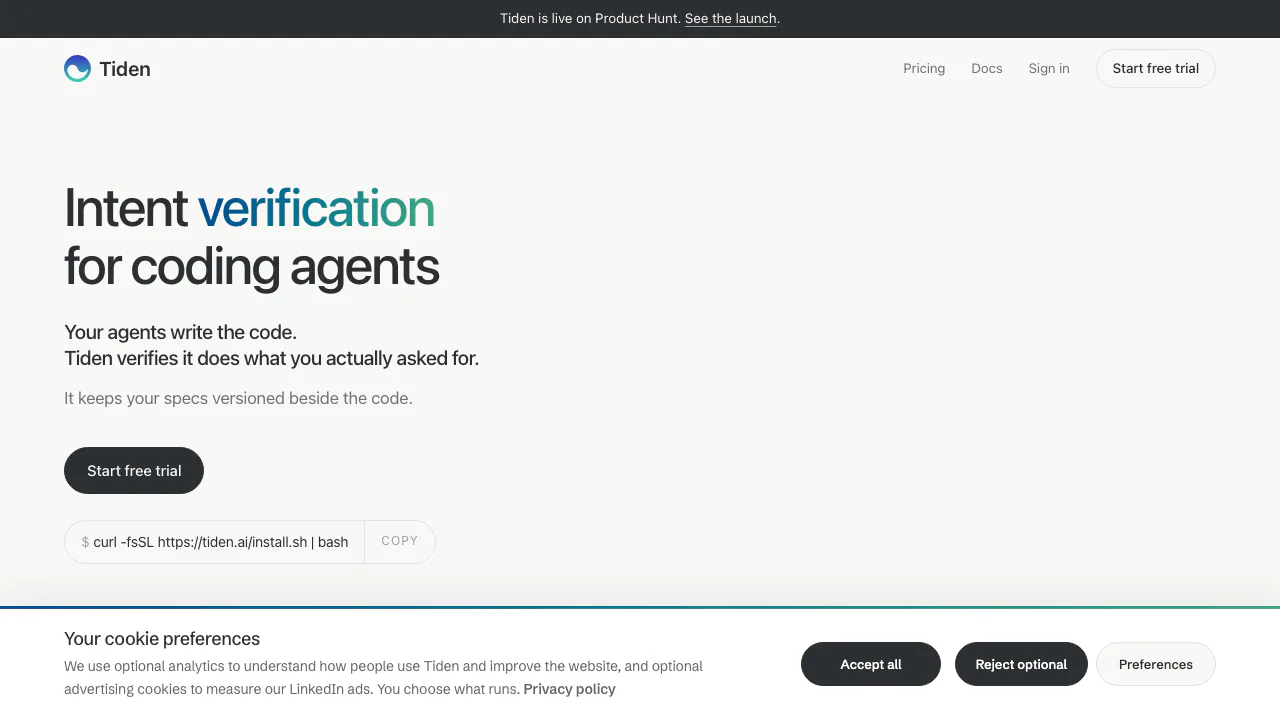
Tiden helps engineering teams check whether software written by coding agents does what they asked for. It brings product specifications, tests, agent sessions and release evidence into one workflow. Qase, Inc. operates the product.
Think of a feature request as a set of promises. If an API must reject requests above a limit and return a retry header, a successful build alone does not show that both promises were kept. Tiden connects those expectations to test evidence and exposes gaps for the team to resolve.
Keep specifications connected to the implementation
Tiden maps product behavior from code and maintains versioned specs. Specs remain editable in Markdown and can carry source references, component ownership, priorities and a hierarchy. This makes it possible to inspect why a behavior exists, rather than relying on an agent's closing summary.
Intent capture records coding-agent sessions and distills their product decisions into reviewable branches. The homepage describes a working contract whose promises must be addressed before a session closes. Generated spec and test changes still need review: the reviewer decides which changes become the accepted product record.
Start with one repository and one behavior
The official quickstart provides a practical onboarding path:
- Create or join an organization, open a workspace and create a product.
- Install the CLI for macOS, Linux or Windows. Run
tiden setupto authorize it and bind your repository, then checktiden config verify. - Connect the Tiden GitHub App to the intended repositories. Add an initial spec through the app or import a Markdown requirement.
- Create a test, link it to the spec and run the relevant checks. Inspect Traceability for
verified,not_runorno_test. - Install intent hooks with
tiden intent install. Check their status and review the resulting intent branch before merging accepted changes.
Choose a behavior with a clear observable result for this first pass. An unresolved expectation or missing test should remain visible, rather than being treated as proof of completion.
Read a release verdict with its evidence
Quality gates combine spec coverage, test results, component risk, evidence freshness and available production issues. They can assess main, a branch or a release. A verdict may pass, block delivery or record accepted risk; the component breakdown explains where attention is needed.
For automation, tiden gate check --product-id <product-id> checks the current product state. A blocked verdict or pending risk review returns a nonzero exit code. Runtime error tracking can connect grouped issues to releases and environments, helping the team relate a production failure to the relevant delivery.
Fit it into an existing agent toolchain
Tiden names Claude Code, Cursor, Copilot and Codex as companion tools. Its CLI, public REST API and local MCP server connect specs, tests, branches and verdicts to automation. Upgrade the CLI and MCP server together because configuration compatibility matters.
This is most useful for developers, QA engineers and engineering leads already shipping agent-written changes. It requires a maintained product model and meaningful tests; it does not turn an unspecified request into a dependable acceptance standard by itself.
Trial, billing and repository access
Checked on October 15, 2026, the public monthly USD prices are $49 for Starter and $199 per product for Team. Starter includes one product, up to three repositories and 25 verified changes each month. Team includes 100 verified changes per product, unlimited repositories and applicable usage charges. Both offer a 14-day trial; continued billing starts on day 15.
A verified change is a pull request merged with a passing quality gate, billed once. Retries, failed changes and bot commits are free. Evidence retention is three months on Starter and twelve months on Team. Consult the current pricing and calculator for overages, telemetry and annual terms; these USD figures are not local tax-inclusive quotations.
Repository connection grants the GitHub App access to selected code. Review those permissions and keep API tokens secure. Telemetry SDKs offer a beforeSend hook to filter events. The privacy policy should be read alongside your agreement; the inspected material does not establish a universal no-training or local-only processing guarantee.
Frequently asked questions
Does Tiden replace a code reviewer?
No. Agents propose branches, and a human reviews and merges the accepted changes. Tiden supplies traceability and evidence for that decision.
Why are passing tests not enough to verify intent?
A passing test supports the behavior it actually checks. Inspect the linked spec, missing coverage and stale or unexecuted tests before treating the requirement as verified.
What do I need for the first verified workflow?
An account, a product, an authorized repository and a concrete spec linked to a test. Start with the quickstart and inspect the Traceability result.
Official resources
- MCP server repository: obtain the official adapter and developer instructions.
- Product changelog: check recent behavior changes.
- Contact Tiden: discuss enterprise deployment or a security review.
Related tools
AI Coding & Developer Tools →
PrompticFreemium
Evaluate and optimize LLM prompts and AI agents with your own test cases
ReflexioFree
Give your AI agents experiential memory and improve continuously without retraining
walkai-talkaiPaid
Voice commands for coding agents, with replies over radio
buddylistFree
Bring coding agents into project chats, reviews and tests.
StarkomandPaid
Run your existing coding CLIs with task briefs, handoffs and code reviews on one canvas.