

Experiential LabsFreemium
One model API with provider routing, spend controls and an open-source gateway.
TrustedRouter private multi-model API router
A privacy-first, OpenAI-compatible gateway for routing AI requests across models and providers.
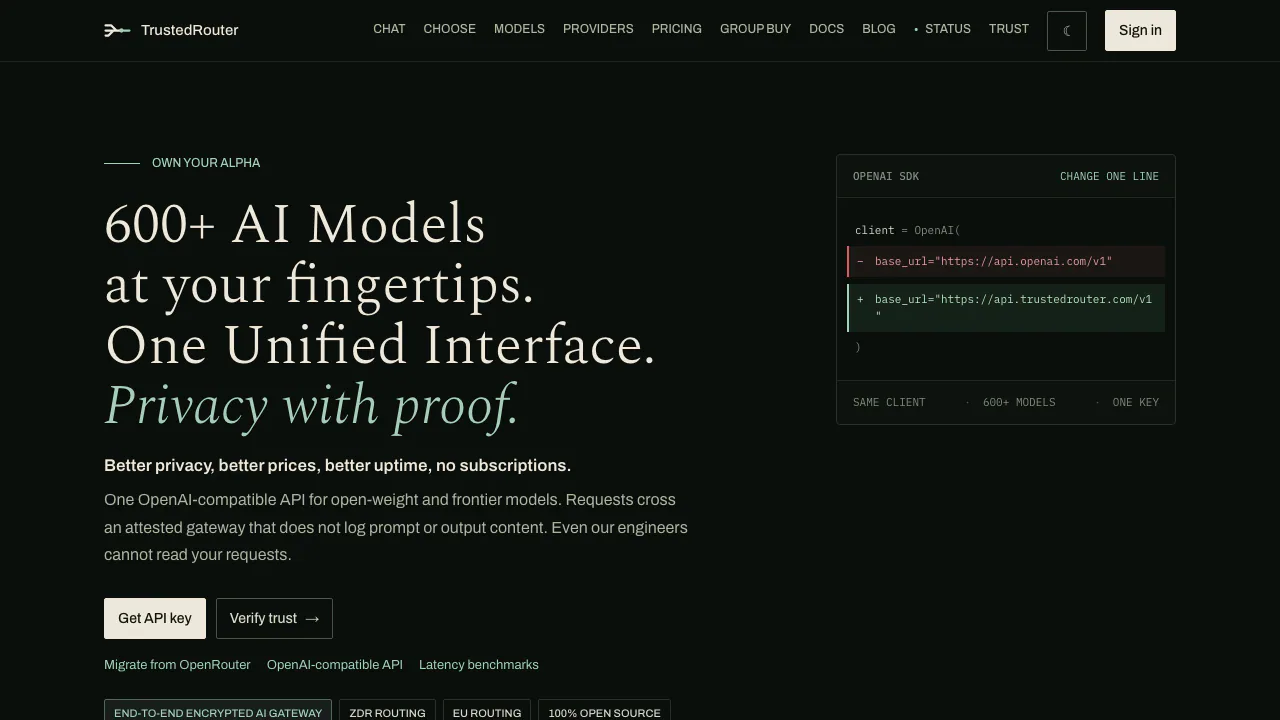
TrustedRouter is a hosted AI model router for developers and teams that want one OpenAI-compatible API across many model providers without turning the gateway into a prompt archive. It combines model selection, provider failover, privacy filters and public trust evidence in one request path.
One API for multi-model applications
Instead of maintaining a separate SDK, key and billing integration for every provider, an application can keep the OpenAI client shape and change its base URL to TrustedRouter. Direct model IDs are available when exact selection matters, while aliases such as <code>trustedrouter/auto</code> can choose a healthy route. The live catalog shows current models, providers, context limits, prices, privacy labels and availability, so production choices do not have to rely on a static marketing list.
This is useful for teams testing the same real prompt across several models, applications that need fallback when one provider is unavailable, and workloads that need an explicit provider or region policy. It is an API infrastructure product, not a replacement for an application-level evaluation plan.
Routing controls for cost, reliability and privacy
TrustedRouter can rank or filter providers, pin a provider, or exclude providers per request. Named routes include general failover, zero-data-retention, confidential-compute and EU-focused options. Privacy minimums are fail-closed: if no eligible route satisfies the requested floor, the call stops before inference instead of silently relaxing the rule.
Provider policy still matters. TrustedRouter can verify its own hosted gateway path, but it cannot make every downstream model provider confidential. Review the model and provider pages before sending regulated or sensitive data.
A practical migration workflow
- Create an API key and store it outside source control as <code>TRUSTEDROUTER_API_KEY</code>.
- Keep the OpenAI SDK request format and set the base URL to <code>https://api.trustedrouter.com/v1</code>.
- Start with <code>trustedrouter/auto</code> or choose a model from the live catalog.
- Run representative prompts and compare answer quality, total cost, first-token latency and failures.
- Add provider, privacy or regional filters only after confirming the required route exists.
A successful response confirms the API path works; it does not prove the selected model is right for every task. Keep a small evaluation set and pin a model or fallback policy when repeatability matters.
Pricing and payment boundaries
As verified on September 2, 2026, there is no monthly subscription. Prepaid text and embedding traffic is billed at the provider price plus 5.5%, with a small floor for free or near-zero routes; asynchronous video jobs use the provider quote plus 20%. BYOK is available when a team already has provider commitments or enterprise limits. Exact model prices change, so check the live pricing page and model catalog before estimating a production budget.
Prompt handling and verifiable trust
TrustedRouter states that ordinary synchronous and streaming inference does not log or retain prompt and output bodies. It keeps operational metadata such as model, provider, token counts, latency, cost, status and region. The opt-in Batch API has a different boundary and may retain enclave-encrypted artifacts for up to 30 days. Downstream providers process content under the selected route's terms.
The public trust page links a live attestation to a published source commit and image digest. That helps users verify which gateway workload is running, but it is not a guarantee that the code is bug-free or that every upstream provider uses confidential compute.
Frequently asked questions
Is TrustedRouter an OpenRouter alternative?
Yes. It offers a hosted, OpenAI-compatible multi-model API with unified routing and billing. Its distinguishing focus is an attested prompt path, public source, explicit privacy aliases and fail-closed privacy filters.
Does TrustedRouter store prompts or outputs?
Ordinary synchronous and streaming inference is documented as content-stateless. Operational metadata is retained, and the optional Batch API may keep encrypted artifacts for up to 30 days. Provider-side handling remains route-specific.
Is TrustedRouter free?
It has no subscription fee, but inference is usage-based. Text and embedding routes carry the published provider cost plus markup; BYOK can use existing provider accounts. Creating a key without a card should not be interpreted as unlimited free inference.
Can I use my existing OpenAI integration?
In many applications, yes: keep the SDK and request shape, change the base URL and use a TrustedRouter model ID. Check the migration guide for compatibility differences before moving a production workload.
Official resources and developer community
- API documentation and quickstarts — integration examples, routing controls and feature guides.
- Security and privacy boundary — prompt handling, metadata and attestation limitations.
- Open-source router repository — inspect the control-plane and website source.
- Service status — current incidents and availability history.
- Official support — product, API, billing, privacy and security help.
Related tools
AI Model APIs & Infrastructure →
OpenRouterFreemium
Unified API Gateway and Router for Frontier AI Models
LLM GatewayFreemium
One API for model routing, usage tracking and provider access
AIsaPaid
One API key for models, research APIs and agent workflows.
TavilyFreemium
Search, extract, crawl and research the live web for AI agents through one API
FirecrawlFreemium
Turn websites into clean Markdown or structured data for AI agents, RAG pipelines, and automation.