

UserlensFreemium
AI-guided product adoption and retention campaigns for B2B SaaS
Monid AI Agent Tool Marketplace and API Router
Discover, inspect, and run agent tools through one balance.
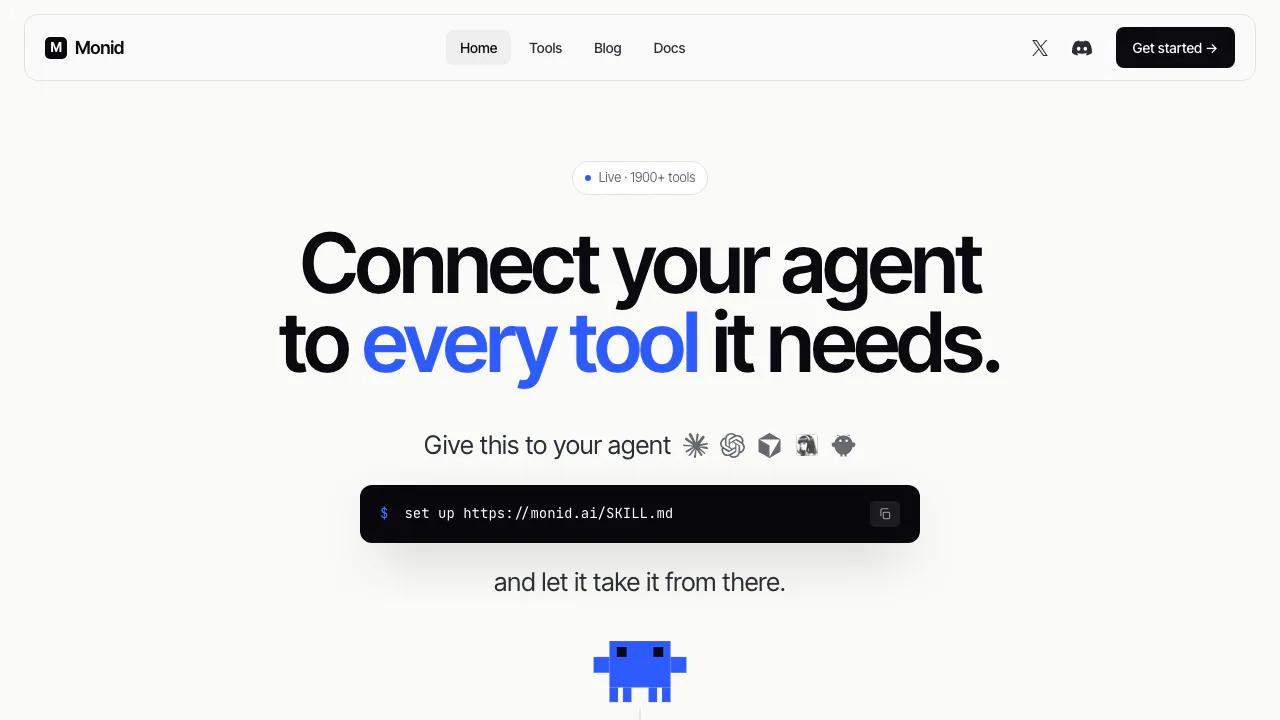
Monid is a developer platform that lets an AI agent discover, inspect, and run external tools and APIs through one integration. It is designed for builders who need live web data, enrichment, social data, scraping, media generation, and other callable capabilities without maintaining a separate account and billing setup for every provider.
What does Monid do?
Monid is a tool aggregation and unified execution platform for AI agents. In plain terms, it works like a “tool marketplace” for language models and agents: through MCP, API, CLI, and other interfaces, it connects an agent to third-party APIs, data sources, and online services.
A language model can understand a request, reason about information, and generate content, but it cannot obtain every piece of live data or connect to every external service on its own. When an agent needs to search the latest web pages, look up company information, collect market data, or use an online service, it needs external tools.
Monid acts as the connection layer between the agent and those tools. An agent can use Monid to:
- Search for a suitable tool based on the current task.
- Review the tool’s purpose, input parameters, output format, and price.
- Select and call the corresponding third-party API.
- Receive structured results and continue the task.
For example, if a user asks an agent to research a company, the agent can use Monid to find company-data, web-search, or market-research tools, call them for current information, and then turn the results into a report.
The flow is:
User request → Agent identifies the external information or capability it needs → Monid finds a suitable tool → Monid calls the third-party API or data service → The result returns to the agent → The agent analyzes it and completes the task.
Monid is not itself a language model or chatbot, and it is more than a single-purpose MCP server. MCP is one supported access method; Skill, CLI, and HTTP API are also available.
Monid is a tool marketplace and unified execution platform for AI agents, allowing them to discover and call third-party APIs, data sources, and online services through MCP and other interfaces.
From a task to a callable endpoint
The central Monid workflow has three stages. First, discover searches the catalog for endpoints that match a natural-language task and returns candidates with provider and pricing context. Second, inspect exposes the selected endpoint’s input schema, documentation, and current pricing. Third, run sends structured input and returns the provider result. This sequence is useful when an agent needs to choose a tool at runtime instead of relying on one hard-coded vendor.
A practical implementation should still validate the returned schema, set a spending policy, and inspect the result before an automated workflow acts on it. Monid reduces integration work; it does not remove the need to review tool permissions, provider terms, or output quality.
Ways to connect Monid
Monid supports several entry points for different environments:
- A hosted MCP server for compatible AI clients.
- A downloadable Skill that teaches supported agents the discover, inspect, and run loop.
- A CLI for terminal workflows and scripted jobs.
- An HTTP API for application code, plus OAuth for platforms acting on behalf of users.
The official quickstarts show how to create an account and API key. Keep that key outside prompts, source control, and logs. For an MCP client, the documented server URL is https://mcp.monid.ai/v1.
Pricing and failure handling
Monid uses usage-based pricing rather than a recurring subscription. Each endpoint can be priced per call or per result, and the price is visible during discovery, inspection, and in the run response. The homepage currently advertises $1 in introductory credit; this is a changeable offer, so verify it before relying on it.
Provider-level errors are documented as uncharged, with actual cost reported as zero. Because endpoint prices, providers, and rate limits can change, inspect an endpoint immediately before a batch and start with a small test call.
Who Monid is best for
Monid is a strong fit for developers building agents that occasionally need many different data or automation services, or teams that want one catalog and balance instead of many vendor subscriptions. A direct provider integration may be simpler for a single stable endpoint used at high volume, especially when latency, support terms, data residency, or a direct contract matters.
Monid’s public site and documentation reviewed for this entry did not expose a clearly linked privacy policy. Before sending personal, confidential, regulated, or commercially sensitive data, confirm the current legal terms and each underlying provider’s data handling rules.
Common questions
Does Monid replace the AI model?
No. Monid is the tool layer around an agent. The model plans the task; Monid helps it find, inspect, and execute external endpoints.
Do I need a separate API key for every provider?
Monid presents one account and balance for catalog tools. You still need a Monid account or supported authorization method, and some endpoint-specific conditions may apply.
Is Monid free?
Discovery and inspection are documented as free. Executing a tool is billed according to that endpoint’s per-call or per-result price. Check the displayed quote before running it.
What happens when a provider returns an error?
The official run documentation says provider errors are not charged. Check both the Monid run status and the provider HTTP status, because a completed run can still contain a provider error.
Official resources and community
- Monid documentation — setup guides and API references.
- MCP quickstart — connect a compatible AI client.
- Pricing documentation — current billing models and price visibility.
- Monid on Discord — community channel linked by the official site.
- Monid on LinkedIn — company updates linked by the official site.
Related tools
AI Coding & Developer Tools →
DialFreemium
A phone identity and communication API for AI agents
SubmitMapFreemium
Plan, automate, and track product submissions across launch platforms
MuleRunFreemium
AI agents, cloud workspaces, and repeatable workflows
LightPDFFreemium
AI PDF editor, converter, and document chat on web, desktop, and mobile
Mastra FactoryFreemium
A shared software factory for coding agents and human reviewers.