

SubmitMapFreemium
Plan, automate, and track product submissions across launch platforms
Dial: AI Phone Number and Voice Agent API
A phone identity and communication API for AI agents
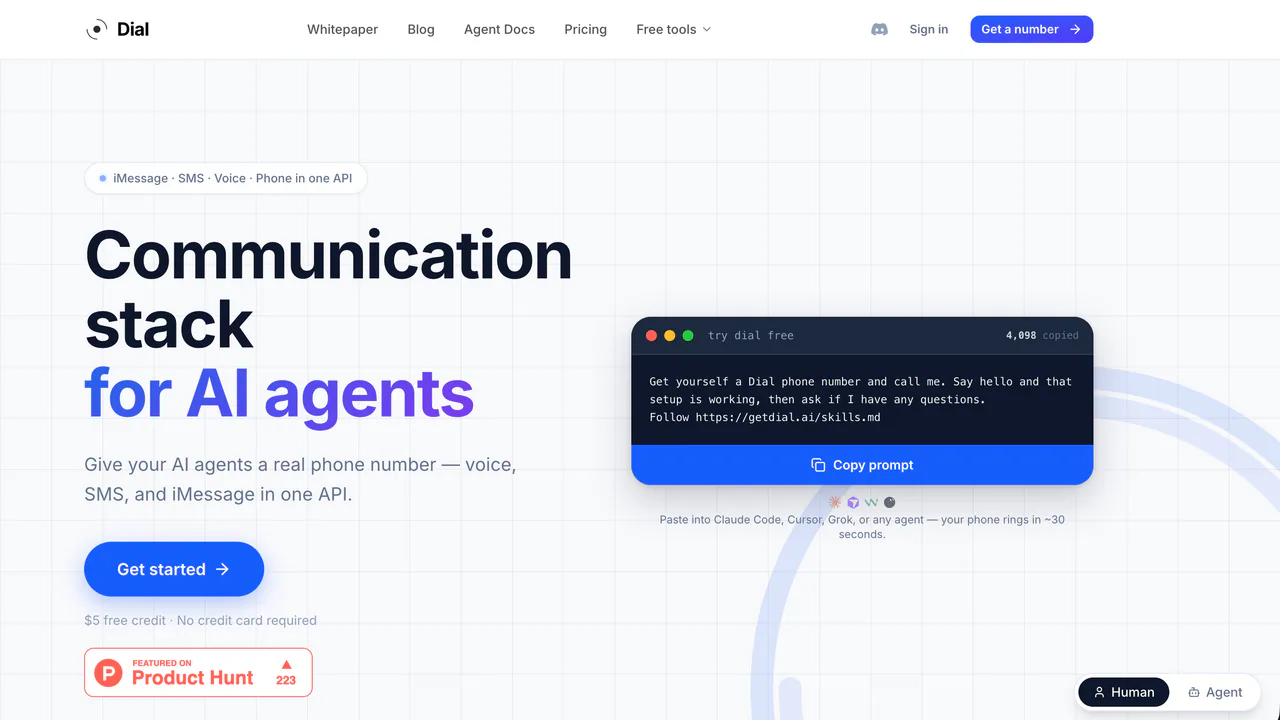
Dial is a programmable communication stack for AI agents. It gives software agents a phone identity they can use for inbound and outbound voice calls, SMS, iMessage and, for enabled accounts, WhatsApp. Developers can control the same account through a REST API, MCP server, command-line tool or SDK.
What Dial does, in plain English
Most AI agents can write text or call software tools, but they cannot independently answer a real phone call or receive a verification code. Dial supplies the missing phone layer. An agent gets a number, then uses commands or API calls to send a message, place a live AI voice call, or react when someone calls or texts back.
Think of it as telephony infrastructure designed for software agents rather than a consumer calling app. It is intended for business and professional use. The agent logic still comes from your application or prompt; Dial handles numbers, communication channels, call execution, event delivery and account history.
Voice, messaging and inbound events
A Dial number can initiate an AI voice conversation from an instruction. When the call finishes, the call record includes status, duration and a transcript. Numbers can also receive calls, with an inbound instruction defining how the voice agent should respond.
Two-way SMS is available from the same programmable surface. iMessage lines add richer messaging, while WhatsApp is currently a per-account beta capability attached to an iMessage line. WhatsApp outbound messages are text-only, and setup must reach the ready state before sending.
Outbound actions return quickly and complete asynchronously. For reliable application workflows, connect an HTTPS webhook. Dial signs webhook deliveries, retries them and provides a stable event ID so your service can deduplicate repeated delivery.
How to give an AI agent a phone number
- Install the Dial CLI or choose the REST API, MCP connection, Node SDK or Python SDK.
- Create an account with a verified email and phone number. The first Dial number is provisioned during onboarding.
- Set the inbound instruction if the number should answer calls, then test a single SMS or voice call.
- Read the final message or call status and transcript. For production use, register a signed webhook for inbound messages and completed calls.
- Add compliance checks, retry safeguards and human review before expanding volume.
The official onboarding guide documents the CLI flow. The SDK overview lists Node, Python, LangChain, Vercel AI SDK, CrewAI, AutoGen and Microsoft Agent Framework packages.
Pricing, free credit and operational limits
As verified on September 4, 2026, Dial advertises a USD 5 signup credit with no credit card required. Pay-as-you-go numbers cost USD 3 per number each month plus metered voice and messaging usage. An optional flat monthly or annual per-number subscription offers unmetered usage; current rates live in the billing dashboard. The current self-serve flat plan is USD 20 per number monthly or USD 200 annually. iMessage numbers remain pay-as-you-go only and cannot be added to that subscription.
Before the first top-up or subscription, calls are limited to five minutes and an account can run two calls concurrently. Those two free-account limits lift permanently after payment. iMessage numbers can start up to 50 new conversations per number per day, with separate sustained-volume and unreplied-recipient limits. WhatsApp access is beta and must be enabled for the account. Check the current usage limits before designing a high-volume workflow.
Privacy, security and compliance questions
Dial processes call metadata, recordings or audio, message content and transcripts to provide the service. Its privacy policy says communications content is hosted on Dial infrastructure, transcription uses a third-party provider, and service providers are currently located in the United States. It also says Dial does not use call recordings, messages or transcripts to train AI models.
The policy does not promise a fixed deletion timetable for account records or communications data. Customers remain responsible for a lawful basis, required notices, consent, carrier rules and the content sent by their agents. Emergency services are blocked, and US outbound messaging may require 10DLC registration. Review the Dial privacy policy, terms and acceptable-use conditions and your local telecom rules before using personal data or automated outreach.
Who Dial is best suited for
Dial is a practical fit for developers and operations teams building appointment confirmation, support, follow-up, verification or notification agents that need a real phone channel. It is especially useful when one agent must use voice and messaging through a shared API instead of stitching together separate products.
It is not a no-code call-center suite, a personal phone service or a guarantee that every number, channel and country is available. Teams that need durable inbound processing should use webhooks rather than relying only on the short-lived live event stream. High-volume outreach also needs explicit legal, consent and carrier review.
Frequently asked questions
Can Dial make and receive AI voice calls?
Yes. A number can place a live AI voice call from an instruction and can answer inbound calls using its configured inbound instruction. Finished calls expose status, duration and a transcript.
Is Dial free?
It is a freemium service, not an unlimited free platform. New accounts receive signup credit, but numbers and ongoing usage follow pay-as-you-go or subscription billing. Free accounts also have shorter-call and concurrency limits.
Does Dial support SMS and WhatsApp?
Dial supports two-way SMS. WhatsApp is a beta channel enabled per account and attached to an iMessage line; outbound WhatsApp messages are currently text-only.
Does Dial train AI models on call recordings?
The current privacy policy says it does not train or fine-tune AI models on recordings, message content or transcripts. Those data still pass through and may be stored by the service, so customers should apply their own privacy and retention controls.
Can I use Dial from my existing agent framework?
Yes. Dial exposes REST, MCP, CLI, Node and Python interfaces, plus framework packages. All interfaces operate the same underlying numbers, calls, messages and events.
Official resources and developer community
- Dial documentation — API, CLI, SDK and capability reference.
- How Dial works — outbound actions, inbound events and voice-call lifecycle.
- Webhook guide — signed, retried event delivery.
- Dial on GitHub — official CLI, adapters and playbooks.
- Dial contact page — product, billing, account and partnership enquiries.
- Dial Discord community — community discussion linked by the official site.
Related tools
AI Audio & Voice Generators →
TadataFreemium
Bring customer research, meeting briefs and reviewed follow-up work into Slack.
UserlensFreemium
AI-guided product adoption and retention campaigns for B2B SaaS
MonidFreemium
Discover, inspect, and run agent tools through one balance.
UdioFreemium
AI music generator for songs, lyrics, extensions, remixes, audio uploads and timeline editing.
MakeBPMFreemium
AI music studio for generating songs, beats, and soundtracks from prompts or lyrics