

AIsaPaid
One API key for models, research APIs and agent workflows.
Tavily Web Search API Review
Search, extract, crawl and research the live web for AI agents through one API
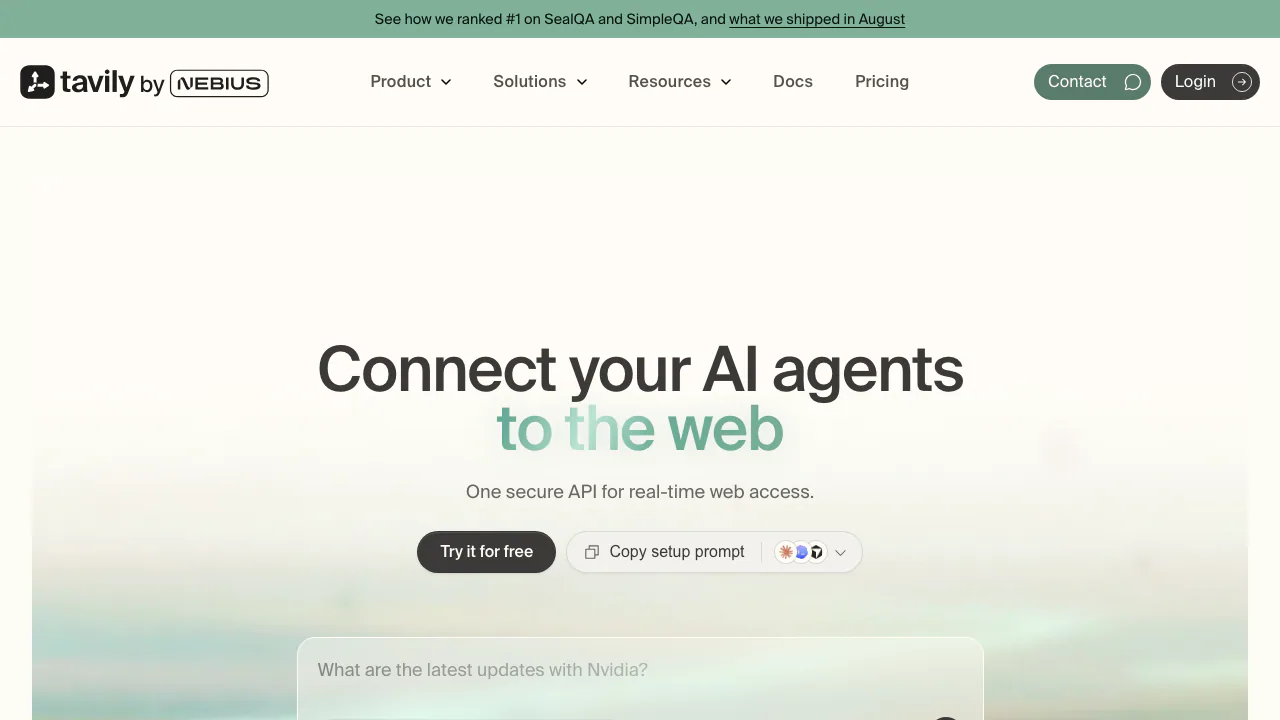
Tavily is a web-data API designed for AI agents and retrieval-augmented generation. Its endpoints cover search, page extraction, site mapping and crawling, plus longer research tasks. Search results can include titles, source URLs, relevant content, scores and an optional generated answer. This reduces the infrastructure needed to find and parse web pages, but it does not turn web content into verified truth.
Build a source-preserving retrieval test
Start with ten real questions from your product, including ambiguous wording, recent events, niche facts and one question whose premise is false. Choose search depth, topic, time range, language and domain filters deliberately. Keep the returned URL beside every excerpt throughout retrieval, ranking and answer generation. A useful result is not merely fluent: a reviewer must be able to open the source, locate the supporting passage and confirm its date and authority.
Use Search for open-web discovery, Extract for known URLs, Map to understand a site's structure, Crawl for bounded multi-page collection and Research only when a task justifies its higher variable cost. Preserve request IDs and, where appropriate, project IDs in logs. Cache results for a measured period, retry 429 and server failures with backoff, and set timeouts and spend ceilings. Do not expose the API key in browser code or mobile binaries; call Tavily from a server-side boundary and rotate leaked keys.
Treat all retrieved pages as untrusted input. A page may contain prompt injection, copied claims, malicious markup or stale information. Separate retrieved text from system instructions, strip unnecessary markup, limit context size, allowlist tools an agent may call and require citations for consequential claims. Domain filters improve focus but can also create a biased source set. Evaluate relevance, citation coverage, freshness, latency, failure rate and credits on a fixed benchmark before production.
Credits and query privacy
Tavily uses credits. The current credit guide lists a recurring free allowance, paid plans and pay-as-you-go. Basic and advanced search have different costs; Extract depends on successful URLs and depth; Crawl combines mapping and extraction; Research has variable minimum and maximum bounds. Model your monthly cost from actual endpoint mix rather than dividing one list price by requests.
The privacy policy states that Tavily collects query data and uploaded documents, may use portions of query data to improve future responses unless a contract says otherwise, and may send query data to third-party search-index providers in limited cases. Do not include personal information, secrets, customer records or internal identifiers in queries. Confirm contractual retention, regional processing and deletion requirements before regulated workloads.
Is Tavily free?
A limited monthly credit allowance is available without a card. Check the live guide because allowances and endpoint costs change.
Does Tavily guarantee accurate answers?
No. It retrieves and ranks web sources, and an optional answer may summarize them. Your application still needs source review, citations and conflict handling.
Related tools
AI Model APIs & Infrastructure →
FirecrawlFreemium
Turn websites into clean Markdown or structured data for AI agents, RAG pipelines, and automation.
LLM GatewayFreemium
One API for model routing, usage tracking and provider access
Experiential LabsFreemium
One model API with provider routing, spend controls and an open-source gateway.
TrustedRouterPaid
A privacy-first, OpenAI-compatible gateway for routing AI requests across models and providers.
OpenRouterFreemium
Unified API Gateway and Router for Frontier AI Models