
MyLens AIFreemium
Turn documents, links and ideas into narrated visuals and individual presentations that viewers can question.
Typezo: RFP response software with page-cited evidence
Turn US solicitation requirements into sourced answers and an editable compliance matrix.
What does Typezo do in plain English?
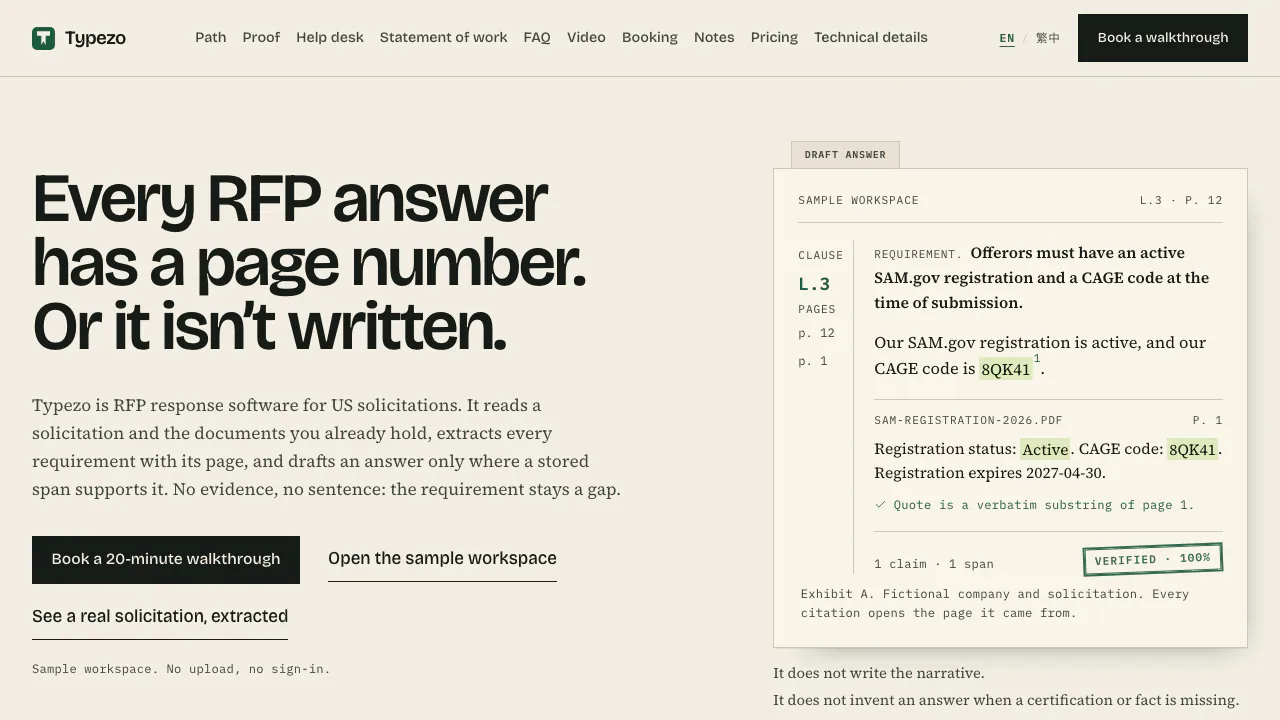
Typezo is RFP response software for small teams answering English-language US solicitations. In plain terms, you give it the buyer’s requirements and your company’s supporting documents. It turns those requirements into a list of answers backed by identifiable passages, leaving a gap where evidence is missing. The deliverables are an XLSX compliance matrix and a DOCX answer draft for your team to review.
From solicitation files to a reviewable response
- Prepare one solicitation and up to 20 company documents, such as evidence of registration, insurance or past work. Upload supported PDF, DOCX or XLSX files; the current version does not fetch a solicitation from a URL.
- Review extracted requirements in their original order, with section and page references. Obligations are marked mandatory or optional; uncertain classifications remain visible for review.
- Open the proposed answers and inspect the cited passages. Check whether the documents actually establish the requested facts and whether qualifications remain current.
- Resolve review items and inspect missing rows before exporting the matrix and draft. Your team still writes narrative sections and submits the bid.
Understand citations, gaps and verification failures
The verifier checks that quotes occur in stored page text, page references match the parser, and numbers, dates and monetary figures appear in cited evidence. Scanned pages use OCR and carry lower confidence, so check those pages carefully.
A missing requirement is an honest result: it receives a gap row and can coexist with a passing run. A failed verification instead marks the run needs_review; exports are watermarked and cannot be treated as clean. These checks establish grounding, not relevance, completeness or the quality of a bid.
Reuse published knowledge in the included help desk
The workspace also includes a tenant-wide knowledge base and help desk. Import documents into collections, review the resulting draft articles and publish them before they become answer sources. Tender work selects a subset of collections; everyday questions use published knowledge across the tenant.
Unsupported questions open tickets. Members see their own tickets, agents manage the queue, and admins manage imports and publishing. Roles currently come from a deployment allowlist; an in-product role editor is not available.
Price, access and security boundaries
Checked on 20 October 2026, the public USD annual plan is $599 per month equivalent, billed $7,188 yearly; the displayed list price is $899 per month. It includes the help desk and 5 million model-weighted input/output tokens each month. Overage costs $15 per million tokens, billed monthly. Failed verification runs are not billed and cache hits are free. Fees exclude applicable taxes; review the current pricing and order terms.
The tender workspace has one login, with no SSO or custom domains in this version. Typezo operates a dedicated instance with a tenant-specific KMS key; self-hosting is unavailable. It states that neither it nor its providers train on customer documents. Prompts nevertheless pass through gateway memory to a model provider, so this is not entirely local processing. Workspace deletion destroys the key first and a signed deletion receipt is issued within 30 days. Read the security and data details.
Typezo holds no FedRAMP, CMMC or SOC 2 certification. Customers retain rights in their content and outputs, while remaining responsible for reviewing the bid under the service terms.
Frequently asked questions
Does Typezo write the entire proposal?
No. It drafts answers requirement by requirement. Executive summaries, win themes and past-performance narrative volumes remain your team’s work; it does not submit to procurement portals.
Is there a free trial?
No free trial or self-serve plan is currently listed. The public sample needs no sign-in and uses fictional data; it does not let you upload your own files.
What happens when evidence is missing?
It leaves the requirement missing and adds a gap row. That is different from a verifier failure and is not permission to invent a credential or claim.
Are customer documents used for AI training?
The vendor says no training by Typezo or its providers. Documents and prompts still require service processing; provider access and retention conditions should be checked before uploading sensitive material.
Official resources
- Open the fictional sample workspace to inspect the experience without uploading files.
- Read the technical workflow for verifier and export boundaries.
- Request a walkthrough to assess a real solicitation with the team.
Related tools
AI RFP Response Tools →
QuelloFree
Ask across your documents and tools, verify the sources, and write with workspace context.
sideOSPaid
Voice commands, local dictation and tasks in your Mac apps
AncherFreemium
Save your sources, find them by meaning, and turn them into useful work.
Chat.shFreemium
A public help center that answers from your own documentation.
LightPDFFreemium
AI PDF editor, converter, and document chat on web, desktop, and mobile