

CrewTowerPaid
Monitor coding agents and answer supported requests from your Mac’s notch.
Kerno: AI API testing against your real backend
Validate backend changes and critical user flows inside your coding agent’s workflow.
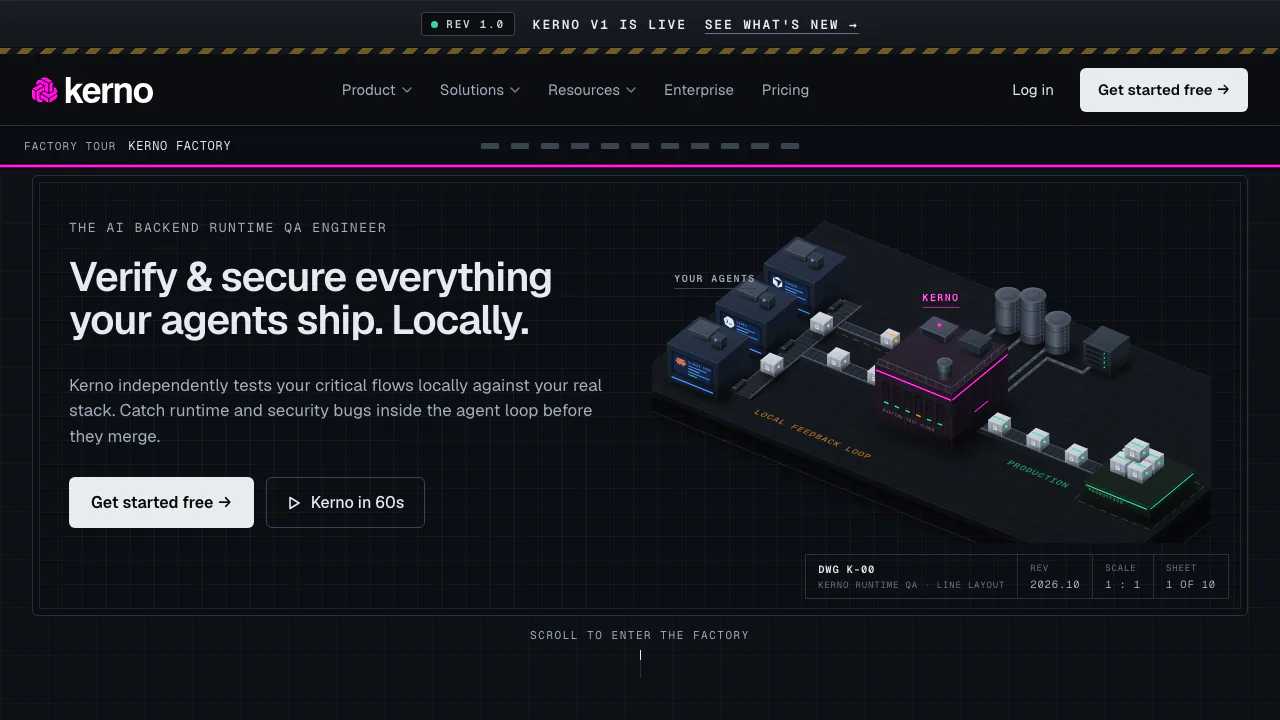
What does Kerno do, in plain English?
Kerno is an AI API testing tool for developers who need to check whether a backend still behaves correctly after code changes. Think of a checkout: a successful HTTP response is useful, but the customer should also be charged once and receive the right order. Kerno can test a journey across several backend entry points and inspect its outcome.
Operated by FYCK Limited, Kerno combines a local agent, an MCP connection to your coding assistant and a web portal for reports. It suits backend developers and QA teams working with a running application and its dependencies.
From API responses to complete backend journeys
Kerno builds a graph of the repository, generates tests and records baseline behavior. After an edit, it identifies affected entry points and reruns relevant checks. The useful output is a difference between expected and actual behavior, including the step that failed in a user flow.
Tests can cover response structures, authentication, permissions, invalid inputs and error handling. Security checks can be requested explicitly. Team rules help express business expectations that a response schema alone cannot capture. When behavior changes intentionally, the suite can be updated; reviewing that distinction remains essential.
Set up a repeatable validation loop
The official quickstart requires Node.js 18+, Git and running Docker or Podman.
- Install the CLI with
npm install -g @kerno/cli, then authenticate withkerno login. - Run
kerno init -w /absolute/path/to/repoand use the MCP connection details it prints. - Connect your coding agent, select the application and supply its running URL and required dependency access. Confirm the environment calibration.
- Ask the agent to map a critical flow, then request a test for that flow. Review the proposed steps and expected outcome before approval.
- Inspect the result, change code and ask Kerno to validate the affected entry points and flows. Investigate differences before accepting a new baseline.
Claude Code, Cursor, Windsurf and Codex are documented setups. The user-flow guide explains plan approval and failed-step reports.
Free allowance and team pricing
Checked on 18 October 2026, the public pricing page lists Community with 30 test runs per month, one repository and one user, without a credit card. A run means one scenario execution: five scenarios consume five runs.
Pro is listed at $50 per developer per month, with unlimited runs and repositories plus team analytics. Enterprise uses custom pricing and adds self-hosting, SSO/SAML and contractual controls. These are the website’s displayed prices; check billing conditions before subscribing.
Compatibility and CI boundaries
Kerno supports HTTP(S), MCP over Streamable HTTP and background consumers. It detects routes in many common backend frameworks and produces TypeScript scenarios. PostgreSQL, MySQL, MongoDB, Redis and message brokers are among supported dependencies. Check the technology matrix: WebSocket, gRPC and GraphQL are still marked coming soon. Kerno works within one repository at a time, including a monorepo.
The pricing page lists CI integration under Pro, while the more specific CI guide documents free standalone replay of committed tests without an account or model calls. Your Linux runner needs Docker and a running app. CI does not generate tests or start the app, and skipped tests must be reviewed separately.
What happens to code and test data?
According to the security documentation, source files and baselines stay local, but relevant code excerpts pass through Kerno’s proxy to model providers using zero-data-retention tiers. Agent-started run reports upload request and response bodies, headers and status codes. Use test data that is appropriate for those reports. SOC 2 Type II is described as in progress.
Frequently asked questions
Can Kerno replace unit tests?
It provides another layer of evidence: runtime checks against a real application and dependencies. It does not establish that every possible behavior is correct or make smaller, targeted tests unnecessary.
What counts toward the free limit?
Each scenario execution counts, including creation, updates and baseline replay through the metered workflow. Thirty runs do not mean thirty complete repository reviews.
Is local testing completely offline?
No. Model reasoning involves code excerpts leaving the machine, and run reports can contain application payloads. Local execution and zero outbound data are different conditions.
Official resources and developer community
- Kerno documentation: installation, troubleshooting and detailed usage.
- Official Slack community: implementation questions.
- Changelog: changes to supported workflows.
Related tools
AI Coding & Developer Tools →
StepFunPaid
Explore StepFun models in AI Studio or integrate coding, multimodal and voice capabilities through an API.
GleapPaid
Connect customer questions, bug investigations and reviewed fixes.
CodemindFreemium
Delegate JavaScript and TypeScript tasks and receive code tested against your acceptance criteria.
DropstoneFreemium
Read repositories, review code changes and carry working preferences across Chat, CLI and SDK.
OpenPilotFree
A desktop coding agent that works in your project folder with the model you choose.