

UserlensFreemium
AI-guided product adoption and retention campaigns for B2B SaaS
Frigade Assist API: AI Product Guidance for Agents
Give your existing AI agent product answers and contextual walkthroughs.
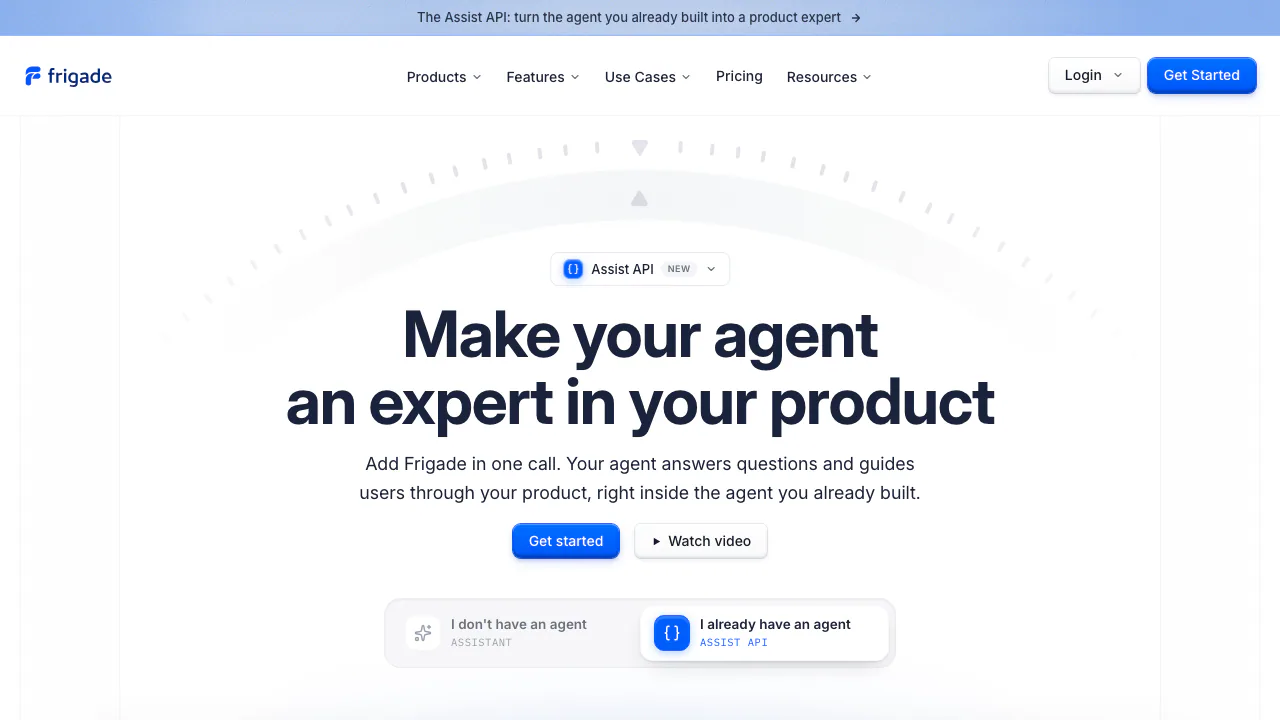
Frigade Assist API adds product knowledge and in-app guidance to an AI agent your team already runs. Built by Frigade Inc., it helps SaaS teams answer product questions and show users how to complete tasks while keeping the existing agent in charge of the conversation.
What does Frigade Assist API actually do?
Think of it as a product specialist your agent can consult. When a customer asks where to configure a setting, the agent can request an answer or an interactive walkthrough of the relevant interface. The user gets help where the task happens, instead of having to interpret a help article and find the right screen alone.
This is most relevant to product and engineering teams that already have an agent but do not want to maintain its product knowledge and guidance paths themselves. Teams without an agent can evaluate Frigade's separate Assistant offering.
From product questions to the next click
The API supports two closely related outcomes: a grounded explanation of the product and contextual guidance through its interface. The host agent decides when to call Frigade and what to do with the response. This preserves the agent's own reasoning, voice and conversation flow.
Guidance is intended to run within the user's permissions. It can help with workflows the product supports, but should not be treated as a way to unlock restricted features. When Frigade cannot help, the system can hand the question back or pass the conversation to a team.
How the product knowledge stays current
Frigade learns by using the application. Its product-tour documentation describes a browser agent exploring a staging copy and building an understanding of the workflows it encounters. Frigade says it retrains as the product changes, reducing the need to rewrite tours after interface updates.
Coverage still depends on the workflows available during learning. A useful evaluation should include different user roles and an interface change; automatic relearning is a product capability, not an independent guarantee that every answer will be correct.
Plan a first integration and check the result
- Start through the official setup or demo process and agree on the product environment Frigade can access.
- Make representative workflows available for learning, including the roles your users actually have.
- Register Frigade as a callable tool in your existing agent. The product page names Vercel AI SDK and describes the approach as framework-agnostic.
- Try a factual product question and a request for an on-screen walkthrough. Check the answer, the highlighted destination and the user's ability to complete the task.
- Test an unsupported request and review how your agent handles the result or escalates it.
These are pilot evaluation steps. Confirm the current package, authentication and response contract during setup rather than treating a short marketing example as a complete production integration.
Let support teams improve the answers
Conversations handled through Frigade are available for review. Support and customer-success teams can rate replies and provide plain-language coaching without editing application code. This gives the people who know product edge cases a way to improve responses.
The broader platform also provides support handoff integrations. Confirm the connectors included in your plan before designing an escalation workflow around them.
Pricing and deployment boundaries
Checked on September 11, 2026: the Assist API page advertises Frigade from USD 1,000 per month with usage-based scaling. Enterprise pricing is custom, including self-hosting options. The free offer on the pricing page is a demo.
That page lists 2,500 queries and two agents under Assistant Growth. Do not assume those numbers define a standalone Assist API allowance: request the applicable API quota, overage pricing and deployment terms for your use case. Published dollar prices are not a local-currency or tax-inclusive quote.
Read the data policy alongside the security claims
The product page describes an LLM zero-retention policy. However, the Assistant privacy policy separately allows supplied data to be used for AI training and improvement, describes retained service data and limits selective deletion of data already incorporated into training.
These statements have different scopes and should not be collapsed into a blanket no-training promise. Before sending production data, confirm the applicable agreement, opt-out process and deployment-specific retention rules with Frigade.
Frequently asked questions
Can I use it without building an agent?
Assist API is designed for an existing agent. Frigade also offers a complete Assistant for teams that want the user-facing assistant supplied for them.
Does it only work with Vercel AI SDK?
No. Vercel AI SDK is explicitly mentioned, while the official requirement is an agent capable of making tool calls. Confirm the implementation details for your stack.
Is there a free API tier?
A free demo is advertised. A permanent free Assist API allowance was not confirmed in the reviewed pricing information.
Does zero retention mean Frigade never trains on my data?
That cannot be concluded from the marketing statement. The privacy policy permits certain training uses and provides a request route to opt out; confirm how those provisions apply to your contract.
Official resources for evaluation and development
- Developer overview: integration capabilities and controls.
- Frigade's GitHub organization: official public projects; their presence does not mean Assist API itself is open source.
- Product updates: release announcements and changes.
Related tools
AI Customer Success Tools →
TypelessFreemium
Speak a draft and turn it into editable writing
Mastra FactoryFreemium
A shared software factory for coding agents and human reviewers.
Gojiberry AIPaid
Find relevant B2B prospects and prepare personalized LinkedIn and email outreach.
MagicSlidesFreemium
MagicSlides is an AI presentation maker that turns a topic, written content or source material into a slide deck you can refine
RelaticleFreemium
An open source CRM for customer records, sales pipelines and AI-assisted work.