

PostizPaid
Plan, adapt and publish social content from one calendar, with AI assistance and a self-hosted option.
Relaticle: Open Source CRM with AI and Self-Hosting
An open source CRM for customer records, sales pipelines and AI-assisted work.
What does Relaticle actually do?
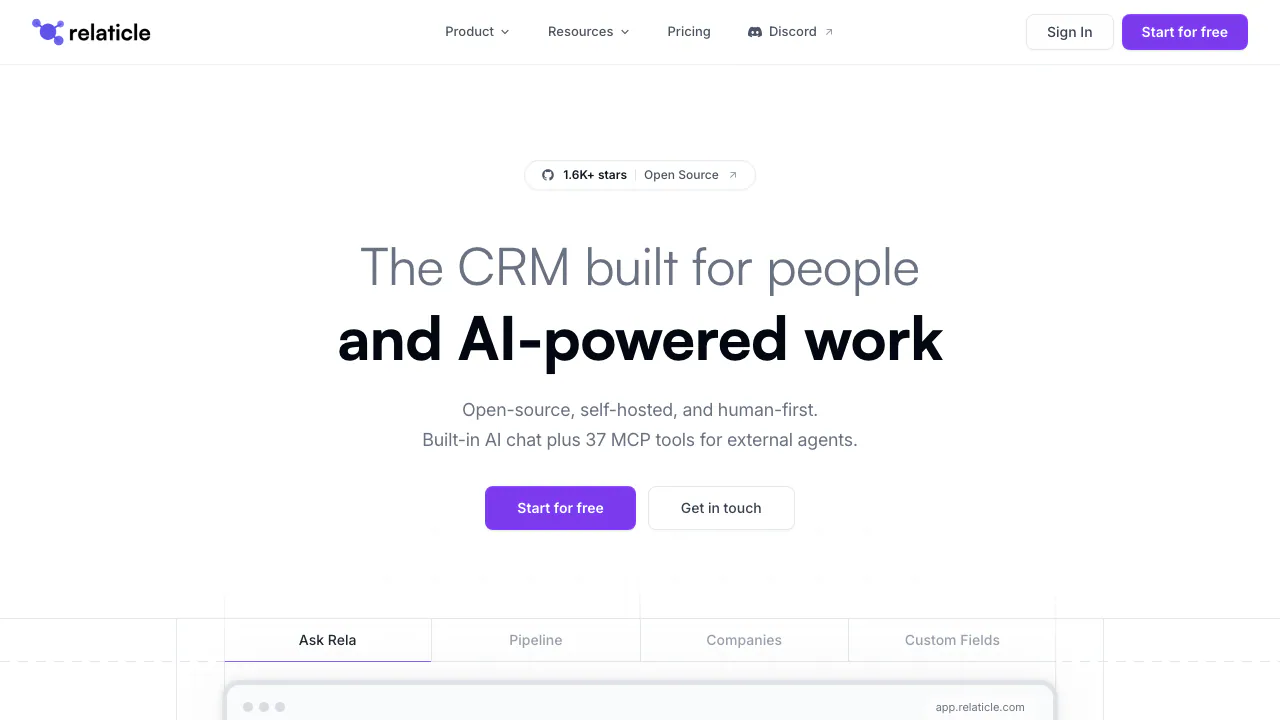
Relaticle is an open source CRM: a shared place to keep track of customers and the work involved in winning their business. Instead of keeping a contact in one spreadsheet, a deal in another and a reminder in someone’s inbox, your team can connect companies, people, opportunities, tasks and notes. It suits teams that want a customizable sales system, with the option to operate the software themselves.
The built-in assistant, Rela, works with those records. You can also connect external AI clients through MCP. These are different ways of accessing the same CRM, with different write-approval behavior.
The official repository currently ships an English-only interface; translating a self-hosted fork requires additional localization work.
Turn customer information into the next sales action
Company profiles connect contacts and opportunity history. A pipeline groups deals into your own stages, helping a team see which opportunities need follow-up. Linked tasks and notes preserve the next action and its context. Role-based permissions and multiple workspaces support collaboration.
Custom fields let you capture information specific to your process. The official site lists 22 field types, including relationships, conditional visibility and encrypted fields. CSV import supports column mapping, validation and error handling; exports offer a route out of the system. Test a small sample and check relationships before migrating a complete customer database.
Ask Rela to update a deal, then review the result
The Rela product page demonstrates a concrete workflow: ask it to mark an existing renewal opportunity as won and set the close date. Review the proposed stage and date, then choose Save changes or Discard. Check the opportunity afterwards. Batch proposals can contain up to 25 records, reviewed individually.
That dedicated page says in-app creates, updates and deletes require approval. The homepage’s older-looking FAQ differs on creates, so verify your installed version’s behavior before relying on it. External MCP writes are a separate case: once authorized, they apply directly rather than waiting for the in-app approval card. The advertised 37 MCP tools and REST API are useful integration options, but access should match the client’s intended job.
Choose self-hosting or managed Cloud
For your own installation, the deployment guide starts with Docker 20.10+ and Compose v2. Download the official compose file, set APP_KEY, DB_PASSWORD and the correct public APP_URL, run docker compose up -d, then create an administrator with docker compose exec app php artisan make:filament-user. Sign in and check that your workspace is available. Incorrect APP_URL settings can break invitation and password-reset links.
The published minimum is one core and 2 GB RAM; 4 GB is recommended for real workloads. You handle updates and backups. Rela needs your own AI provider key or a configured local Ollama model; it has no provider configured by default.
As checked on September 10, 2026, official USD pricing lists Cloud Pro at $24 per workspace monthly, or $228 billed annually, equivalent to $19 monthly. It includes unlimited users and records, a 14-day trial and 2,000 monthly AI credits. Self-hosted software is free under AGPL-3.0, but defaults to 300 monthly assistant credits and does not eliminate infrastructure or provider charges. Credit use varies by model and tool calls; direct REST API and MCP use does not consume built-in chat credits. Enterprise starts at $20,000 yearly with an agreed scope. These are official USD figures, not a claim about local tax or payment availability.
Know where customer data goes
Self-hosting keeps the CRM on infrastructure you control. Configuring an external AI provider or connector can send authorized data to that provider, under its own terms. A local model offers a different deployment path. Relaticle states that it does not train AI models on CRM data; this does not replace checking a connected provider’s policy. See the privacy policy.
Frequently asked questions
Is Relaticle free to use?
The self-hosted software is free. Managed Cloud is a paid service after its trial, and hosting or model-provider costs can still apply to your own installation.
Does adding teammates increase the price?
The published plans have unlimited users and no per-seat charge. AI usage and the agreed service scope remain separate considerations.
Can I run it on my own server?
Yes. Use the official Docker deployment path and plan for backups, updates and AI provider configuration.
Official resources and developer community
- Developer documentation: deployment, MCP and REST API guides.
- GitHub repository: source, license, releases and issues.
- Discord community: deployment questions and community help.
- Contact form: hosted-service and implementation inquiries.
Related tools
AI Marketing & Sales Tools →
LLM GatewayFreemium
One API for model routing, usage tracking and provider access
Mastra FactoryFreemium
A shared software factory for coding agents and human reviewers.
PR LensFreemium
See a pull request’s architecture and data flow before reading the diff.
ReflexioFree
Give your AI agents experiential memory and improve continuously without retraining
Gojiberry AIPaid
Find relevant B2B prospects and prepare personalized LinkedIn and email outreach.